Biometric Access Control Comparison: Which Method Works Best?
By Kojo Mensah • 24th Apr
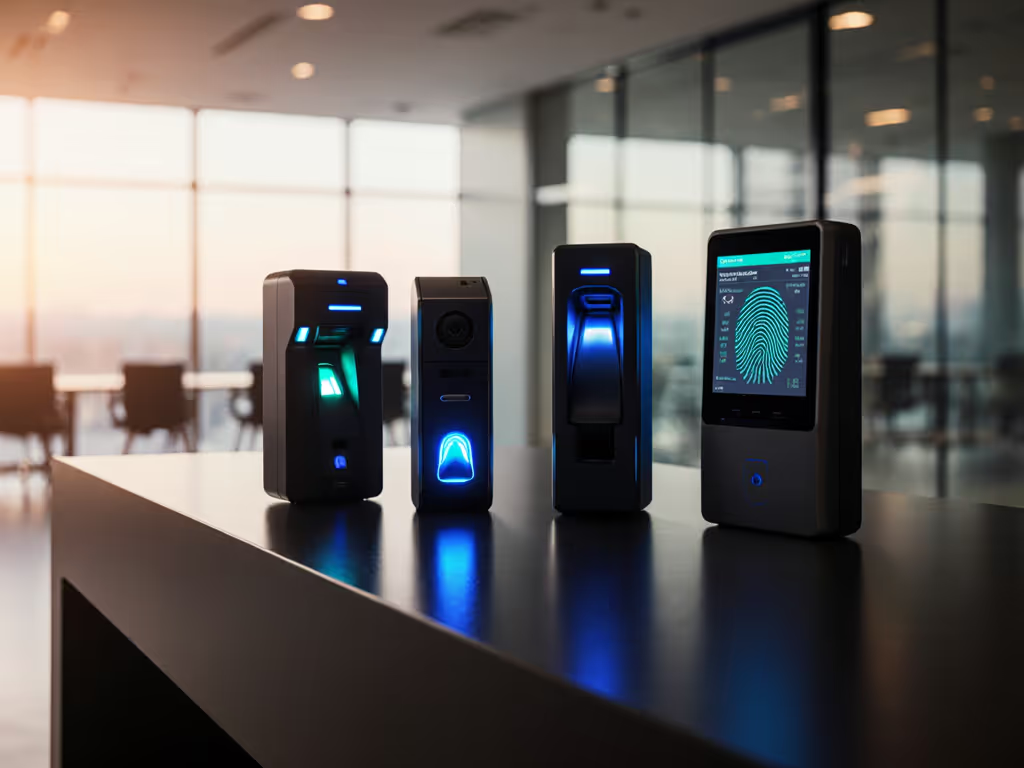
When deciding which access control authentication method works best for your facility, the choice between biometric options hinges on three factors: accuracy, data governance, and operational friction. Each biometric system trades off recognition speed, enrollment overhead, and, crucially, the sensitivity of the biometric data it collects and retains.
This guide walks through the major access control authentication methods using a framework rooted in data minimization: collect less, control more.
How Biometric Access Control Works: The Data Pipeline
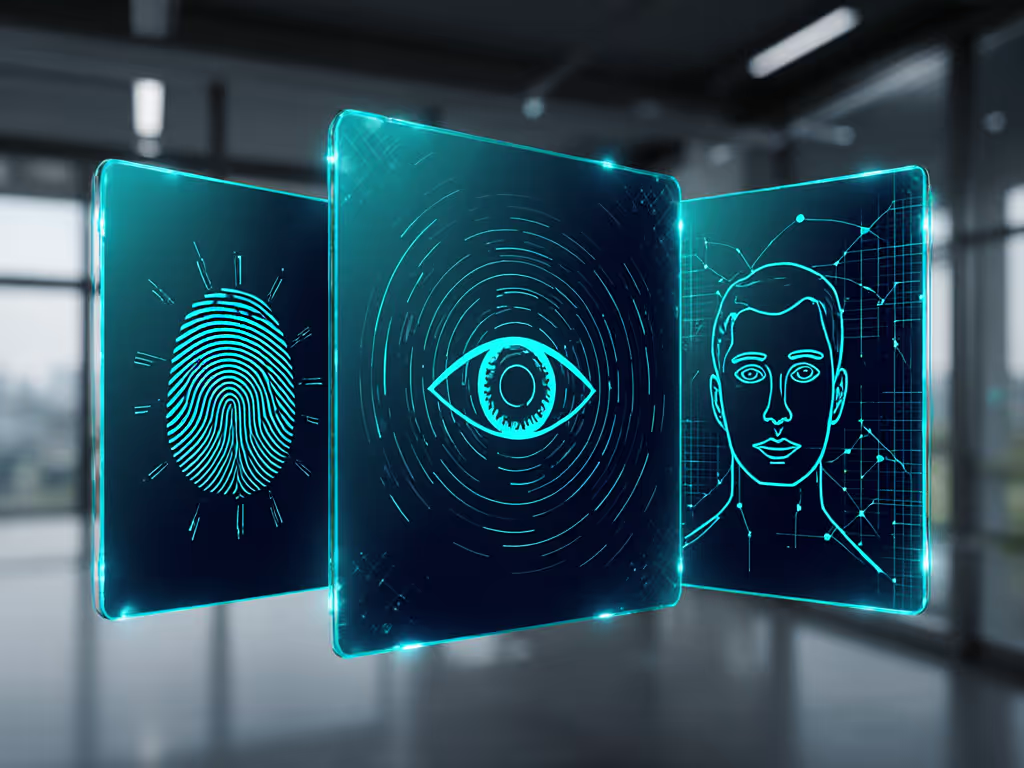
Before comparing individual methods, understand the common architecture. All biometric systems follow a three-stage sequence.[3][5] First, during enrollment, a person's biometric features (fingerprints, face, iris, voice, or palm vein) are scanned and converted into a digital template stored in a secure database.[3] Second, when access is requested, the system captures the biometric feature again in live capture.[5] Third, matching algorithms compare the live capture to the stored template in a lightning-fast verification process.[4] If characteristics match, the system grants access; otherwise, it denies entry.
The critical privacy question: where and how long is that template stored? Is it encrypted? Can it be extracted? This is where data control (or its absence) becomes apparent. For device-hardening steps that apply to connected security endpoints, see our guide to protecting security cameras from hackers.
FAQ: Comparing Biometric Access Control Methods
What Is Fingerprint Recognition and How Reliable Is It?
Fingerprint recognition remains the most widely deployed access control authentication method globally.[5] The technology works by mapping unique ridge patterns on the finger to a mathematical template.[5] During enrollment, a scanner captures multiple angles of the fingerprint; during access, a single touch is compared to the stored template.
Reliability and Performance:
Fingerprint systems deliver consistent, measurable accuracy. The technology is fast (recognition occurs in under one second) and cost-effective, with fingerprint recognition reliability proven across millions of deployments in office access, high-security facilities, and consumer devices.[5]
Data Minimization Angle:
Fingerprint templates are relatively compact, approximately 20-30 kilobytes per finger. Retention policies can be aggressive: delete templates after employment termination or contract end. However, if fingerprints are lifted from surfaces, attackers can create fake fingerprints through spoofing attacks. Hybrid multi-factor authentication (MFA) mitigates this risk: require both fingerprint and a PIN or RFID badge.[6] As noted in security literature, "Hybrid biometrics combine a form of biometric security with another access control method," ensuring that even if one credential is compromised, a second factor remains.[6]
Practical Considerations:
Cost-effectiveness makes fingerprint systems accessible for small to mid-size deployments. The technology does require hands-on contact; in environments emphasizing hygiene, this may be a concern. Worn or scarred fingers may yield higher rejection rates, occasionally frustrating authorized users.
How Does Facial Recognition Compare in Accuracy?
Facial recognition uses 2D or 3D images of a person's face, analyzing landmarks such as eye distance, nose shape, and jawline.[3] The system converts these measurements into a mathematical code (2D) or an infrared depth map (3D). During the initial scanning process, lighting and position must be optimized to ensure an accurate image for the biometric template.[3]
Reliability and Performance:
Facial recognition provides contactless, hands-free authentication, enabling faster user throughput in high-traffic areas.[3] Facial recognition accuracy performance depends heavily on environmental conditions: poor illumination, backlighting, sunglasses, and head angle can degrade results.[3] In controlled lighting, the system achieves strong performance; in outdoor or variable-light scenarios, accuracy may degrade.
Data Minimization Angle:
Facial recognition templates are substantially larger (100-500 kilobytes per face) and encode more granular biometric information than fingerprints. The ethical weight is higher: a face is visible to the public, identifiable across contexts (e.g., CCTV, social media), and cannot be "changed" like a PIN. Retention policies must be strict. Encryption in transit and at rest is non-negotiable. If facial templates are compromised, reconstructing an approximate image of the person's face from the template is theoretically possible, amplifying privacy risk.
Practical Considerations:
Contactless operation is hygienic and requires no physical wear-and-tear on scanner components. Ambient light variability, reflections, and disguises (hats, masks) introduce environmental sensitivity. Facial recognition may invoke heightened privacy scrutiny depending on jurisdiction and public sentiment. For a technical look at ethical AI facial recognition accuracy across demographics, review our comparison.
What About Iris and Retinal Scanning?
Iris and retinal scanners analyze unique patterns in the eye. Iris scanners capture the pattern of the colored part of the eye, while retinal scanners map blood vessel patterns at the back of the eye. Both deliver exceptional uniqueness and consistency.[2]
Reliability and Performance:
These methods achieve the highest intrinsic accuracy among biometric modalities, with false rejection rates below 1% and false acceptance rates below 0.01%.[5] However, both require closer user proximity and cooperation (typically 4-12 inches from the scanner) and are slower than fingerprint or facial recognition.
Data Minimization Angle:
Iris and retinal templates are extremely sensitive. They encode medical information; blood vessel patterns may correlate with health conditions. Retention obligations may be stricter under healthcare privacy laws (HIPAA, GDPR). However, iris and retinal patterns are not visible to casual observation, unlike faces. If the system is isolated and templates encrypted, ambient privacy risk is lower than facial recognition, despite higher intrinsic data sensitivity.
Practical Considerations:
Ideal for high-security environments (government, financial, medical records) where accuracy is paramount. Unsuitable for high-throughput, low-friction scenarios. Poor compatibility with contact lenses (retinal scanners); iris scanners are contact-lens tolerant. Hardware cost is substantially higher than fingerprint systems.
How Does Voice Authentication Compare?
Voice authentication analyzes unique vocal characteristics (pitch, rhythm, resonance) to verify identity.[2] Unlike visual biometrics, voice can be captured remotely and is inherently continuous: people can be recognized by listeners without physical proximity.
Reliability and Performance:
Voice authentication security remains the weakest among single-modality biometric options. False rejection rates range from 5-10%, highly variable with background noise, illness, or emotional state.[5] False acceptance rates of 1-5% are substantially higher than fingerprint or facial recognition. Speed ranges from 3-10 seconds, which is slower than visual methods.[5]
Data Minimization Angle:
Voice is continuously identifiable in ambient environments, making privacy risk high. Audio recording and retention are heavily regulated in many jurisdictions (wiretap laws, two-party consent). If voice templates are leaked, an attacker can recreate audio impersonations (voice cloning). For these reasons, voice authentication is rarely the sole access control method.
Practical Considerations:
Voice is highly susceptible to noise, illness, and emotional state. No physical contact minimizes friction. Best used in multi-factor scenarios rather than as a primary control. Privacy-sensitive in jurisdictions with recording consent laws. Vulnerable to replay attacks (recording a "pass" phrase and replaying it).
What Are Palm Vein Scanners?
Palm vein scanners map the vein patterns inside the hand using near-infrared light. The scanner projects infrared, captures the hemoglobin signature of blood vessels, encrypts the pattern, and compares it to a stored template.[6]
Reliability and Performance:
Palm vein technology achieves performance comparable to iris scanners, with false rejection rates of 0.01-0.5% and false acceptance rates below 0.001%.[5] Recognition is sub-second and very fast.[5] The technology delivers speed approaching fingerprint systems with accuracy approaching iris systems.
Data Minimization Angle:
Vein patterns are internal and not visible to casual observation, reducing ambient privacy leakage. However, they encode medical information (blood vessel health). Vein patterns are essentially unchangeable over a lifetime, so breach risk is persistent. The template size is moderate (50-150 KB). Vein patterns are difficult to forge or spoof without drawing blood, raising the attack barrier substantially.
Practical Considerations:
Palm vein systems deliver the highest FAR performance among single-modality biometrics. No social privacy concerns from external visibility. Requires steady hand placement, limiting throughput in high-traffic areas. Specialized, expensive hardware with limited vendor ecosystem. Ideal for high-security, low-traffic environments (executive vaults, research labs, financial safes).
Comparing Biometric False Positive Rates Across Methods
| Biometric Method | False Rejection Rate (FRR) | False Acceptance Rate (FAR) | Verification Speed | Data Sensitivity |
|---|---|---|---|---|
| Fingerprint | 1-3% | 0.01% | < 1 second | Moderate |
| Facial Recognition | 2-5% | 0.001-0.01% | 0.5-2 seconds | High |
| Iris Scan | < 1% | < 0.01% | 4-12 seconds | Very High (medical) |
| Retinal Scan | < 1% | < 0.01% | 4-12 seconds | Very High (medical) |
| Voice | 5-10% | 1-5% | 3-10 seconds | Very High (privacy) |
| Palm Vein | 0.01-0.5% | < 0.001% | < 1 second | High (medical) |
Designing for Data Control and Retention
A system's security and privacy posture depend not only on which biometric method you choose but on how you govern the collected data. The most secure technology becomes a liability if templates are retained indefinitely, stored in plain text, or shared carelessly. Consider these governance principles:
Enrollment Minimization:
Collect only the minimum number of biometric samples necessary for reliable matching.[5] Example: one iris scan per eye is sufficient; ten scans introduce bloat without accuracy gains.
Template Encryption:
Store all biometric templates with AES-256 encryption at rest. Encrypt transmission between scanner and database using TLS 1.3 or better. Do not store plain-text or lightly hashed templates. Planning ahead? Consider post-quantum encryption standards to future-proof biometric template protection.
Retention and Deletion:
Define a data retention policy: for example, "Delete templates 30 days after employee termination." Implement automated purge jobs; verify deletion through audit logs. For high-security environments, require cryptographic key destruction (the template becomes unrecoverable).
Access Logging:
Log every template lookup, every match, every denial. Tie logs to the physical access outcome (door opened, access denied). Retain logs for compliance periods (often 1-3 years) but not indefinitely.
Local vs. Cloud:
Local storage means templates are stored on an on-premises database or access control panel. For wider context, here’s a practical cloud vs local storage guide for security systems. You retain higher privacy control; no third-party intermediary. The trade-off is managing your own backup and disaster recovery.
Cloud storage means templates are sent to a vendor's cloud. Convenience of remote management comes with higher privacy risk if the vendor is breached or policies change. Verify encryption in transit, encryption at rest, and jurisdictional data residency.
I learned this principle firsthand when a neighbor's doorbell footage ended up in a viral group (faces and plates fully exposed, shared without malice, just frictionless sharing). The friction you deliberately introduce at collection time prevents leaks downstream. Control is a feature.
Multi-Factor Biometrics for High-Security Contexts
For environments demanding failsafe security (financial institutions, data centers, research facilities), hybrid biometrics combine two or more modalities. Unlike passwords or keys that can be stolen, biometric traits cannot be easily duplicated, reducing risks of unauthorized access significantly.[5] To reduce systemic risk, align teams using physical-cybersecurity convergence practices.
Common combinations include fingerprint plus iris (both must match), facial recognition plus PIN, or iris plus RFID badge. Each additional factor reduces false acceptance rates exponentially while increasing user friction (false rejection). The trade-off depends on the threat model and tolerance for friction.
Which Method Is Best?
The honest answer: it depends on your threat model and tolerance for friction.
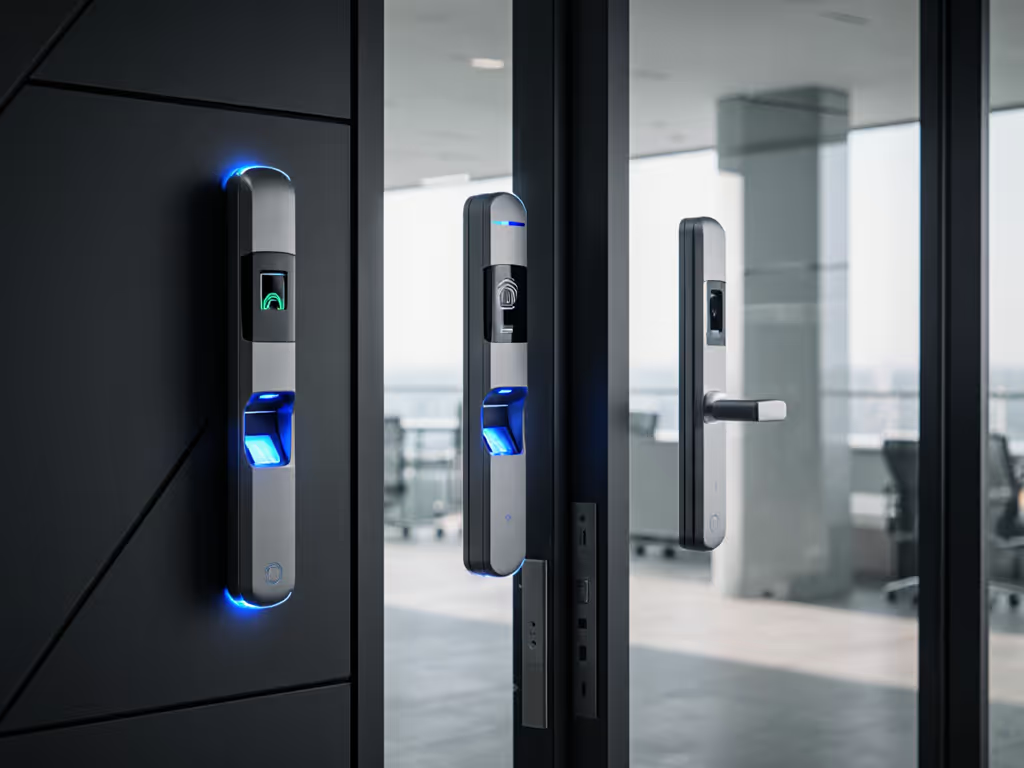
Fingerprint systems balance cost-effectiveness, speed, and adequate security for most office and small-business environments. Mitigate spoofing risk with multi-factor authentication.
Facial recognition suits high-throughput, low-friction scenarios (lobbies, visitor intake, campuses) where environmental variability is accepted and contactless operation is valued.[3]
Iris and retinal systems deliver maximum accuracy and intrinsic security. Ideal for vaults, government facilities, or environments with compliance mandates (healthcare, financial records). Accept slower throughput and higher privacy burden (medical data classification).
Palm vein systems achieve fingerprint-level speed with higher spoof resistance and no social privacy concerns. Cost and limited ecosystem are trade-offs.
Voice authentication should be deployed only as a supplementary factor in multi-factor scenarios (avoid as a sole modality) due to high false rejection and false acceptance rates.
Further Exploration
The choice of biometric method is only half the battle. The governance framework (encryption, retention, deletion, logging, and local vs. cloud architecture) determines whether your system strengthens privacy or becomes a liability in a breach.
Before deploying any system, ask your vendor these critical questions:
- Where are biometric templates stored: on-site, cloud, or hybrid architecture?
- How are templates encrypted at rest and in transit? Which encryption standards?
- What is the default retention period, and can it be customized per user or role?
- Are templates automatically deleted after employee offboarding or contract termination?
- How are template lookups and access attempts logged, and who can access logs?
- Can you extract templates for backup, migration, or third-party audit?
- What is their incident response plan if templates are compromised? How quickly will you be notified?
- Are logs retained indefinitely, or is there a purge schedule?
These questions frame the conversation around data control and resilience. The method itself is only as trustworthy as the infrastructure that contains it. A fast, accurate biometric system built on loose retention and weak encryption creates more risk than a slightly slower system with rigorous data governance. Privacy and reliability reinforce each other; when you control the data, you control the risk.
Related Articles