Bosch DIVAR IP 7000: Enterprise VMS Review
By Kojo Mensah • 27th Mar
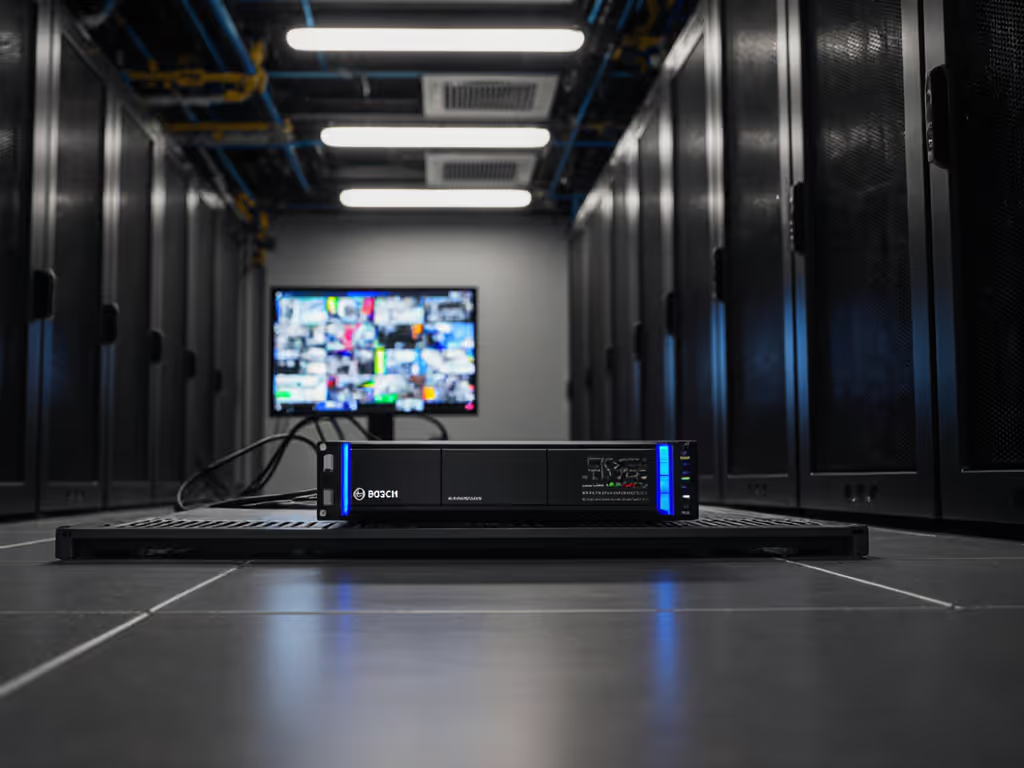
The Bosch DIVAR IP 7000 review reveals a system built on a principle many security practitioners embrace: keep your data local, keep your control absolute. As an enterprise video management system, the DIVAR IP 7000 series represents a shift away from cloud-first architecture toward infrastructure that you operate and own. This matters more than marketing copy might suggest.
Years ago, a neighbor's doorbell camera captured footage of our street (license plates, faces, gait patterns), and within hours it had circulated through a neighborhood group chat. No malice, just convenience. The friction of downloading and securely sharing video was simply missing from that system's design. That experience shaped how I evaluate VMS appliances today: architecture reveals intention. The DIVAR IP 7000, built as a physical appliance with on-premises recording, embodies the opposite instinct. Control is a feature.
This review examines the DIVAR IP 7000 family not as consumer-grade equipment, but as an enterprise framework for organizations seeking to minimize data exhaust while maintaining audit-ready recording. For property managers, facilities teams, and IT-aware operators, understanding how this system enforces local-first recording and multi-tier redundancy is essential to threat-model your security posture correctly.
Architecture: Local Recording as Default
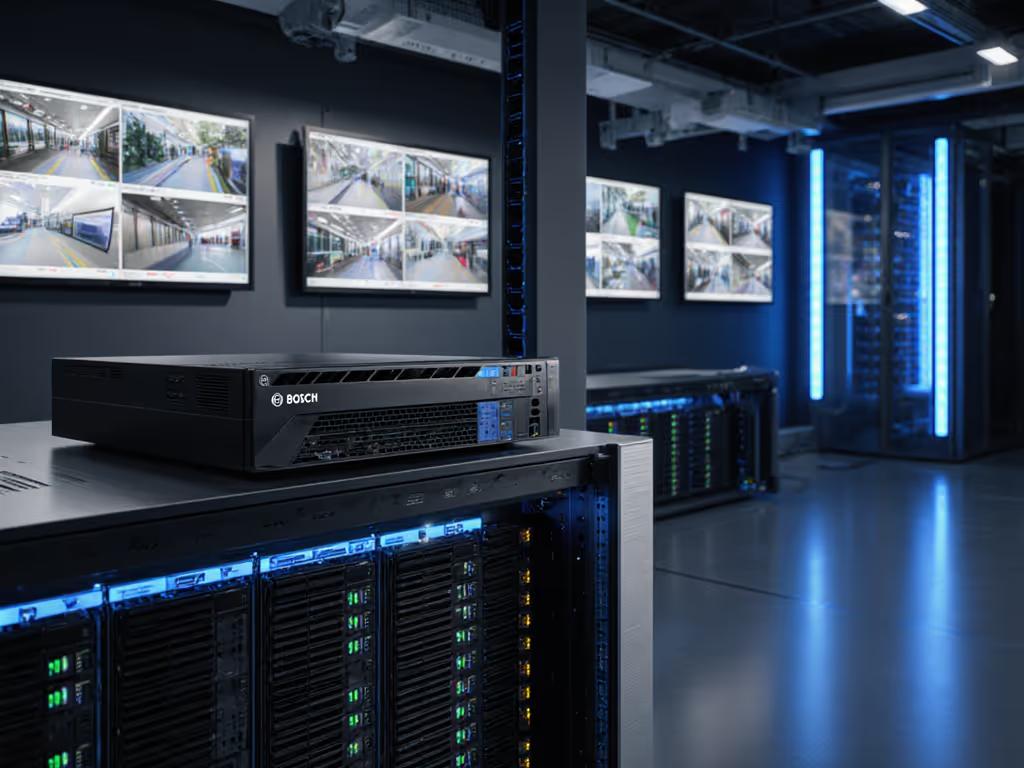
The DIVAR IP 7000 operates as a rack-mounted network video recorder (NVR), available in 1U, 2U, and 3U form factors. This is not a cloud service with local caching. It is a dedicated appliance designed to manage IP cameras and video streams entirely on-premises. The distinction matters: architecture determines where your footage lives, who has access keys, and how difficult it is to accidentally or deliberately exfiltrate data.
At its core, the system uses enterprise-rated hard drives in RAID-5 fault-tolerant configurations, with optional RAID-6 redundancy. Storage density varies by chassis. The 2U model supports up to 8 hard drives with a maximum gross capacity of 44,688 GB (net capacity: approximately 33,516 GB after RAID overhead) when configured with eight 8 TB drives. The 3U variant accommodates up to 16 drives, enabling gross storage of 156,408 GB. These specifications allow organizations to calculate retention policies precisely: at 550 Mbit/s bandwidth capacity, the math becomes transparent.
Capacity Planning and Retention Control
Transparency in storage capacity is foundational to privacy. The datasheets specify net capacity for RAID-5 without hot spare, meaning you can calculate exactly how many days of recording a given configuration supports. This is the inverse of cloud subscriptions, which hide duration behind vague "unlimited" language.
For example, a 2U DIVAR IP 7000 with eight 8 TB drives yields 44,688 GB gross capacity. Accounting for RAID-5 parity (roughly 25% overhead), you retain approximately 33,516 GB of usable space. Bandwidth at 550 Mbit/s equates to roughly 247.5 GB per hour per stream. If a site runs 32 concurrent recordable cameras (32+ pre-licensed base), you can estimate retention windows in advance. This precision is absent from cloud systems that tier pricing by "premium retention" or force yearly subscription renewals.
The hot-swappable front-accessible SATA drives enable replacement without downtime, critical for uptime-dependent deployments. Combined with redundant power supplies (92-96% efficiency ratings), the system tolerates hardware faults gracefully.
Operational Scope: Camera Count and Codec Flexibility
The DIVAR IP 7000 series scales in steps. The 1U model supports up to 64 channels with 4 GB system memory and an Intel Xeon Quad Core processor. The 2U supports 32+ pre-licensed (expandable to 128+) IP cameras or encoders. The 3U reaches 256 maximum concurrent recordable cameras with 16 GB system memory and a Hexa Core Xeon processor.
This variance in processing power is significant. Enterprise deployments don't homogenize: some sites need moderate scale with low latency; others need dense streams with forensic replay. The modular approach allows operator choice.
The system integrates IP cameras and encoders, meaning legacy analog equipment can coexist with modern IP gear via external encoders (a practical concession for phased migrations). If you're planning a phased migration, compare options in our CCTV-to-IP hybrid upgrade paths guide. The Bosch Video Management System (BVMS) backend handles codec negotiation and recording scheduling, reducing manual configuration friction.
Power Efficiency and Environmental Impact
Enterprise appliances accumulate operating costs that dwarf purchase price over five years. The DIVAR IP 7000 series achieves power consumption in the 230-331 W range depending on configuration (1U to 3U, drive count variability). These measurements assume workload-dependent variance, actual consumption fluctuates with recording bitrate and compute load.
For context: a 2U unit with four 8 TB drives draws approximately 282.5 W. Running continuously, that is roughly 2,478 kWh annually (282.5 W × 24 hours × 365 days / 1,000). At average U.S. industrial power rates (~$0.10 per kWh), annual operational cost hovers around $248 per unit, not negligible across a multi-site deployment.
The dual 92-96% efficient power supplies with 0.96-0.98 power factors mean the system operates with minimal waste and cleaner grid demand than older equipment. This matters less for single installations than for portfolios spanning dozens of properties.
Management and Integration: BVMS Ecosystem
The system runs on Windows Server 2008 R2 or newer, and software comes pre-installed and pre-activated. This removes the typical Linux learning curve but introduces Windows patching obligations and licensing considerations for IT departments.
The Bosch Video Management System (BVMS) provides event and alarm management, system health monitoring, user and priority management, and role-based access control. These capabilities enable threat-model framing: you can define exactly which users see which camera feeds, audit access logs, and enforce password policies without external identity services.
The architecture is centralized: BVMS runs on the appliance itself, eliminating dependency on a separate management server. For smaller deployments (up to 64 channels), this simplifies topology. For larger estates, the 2U and 3U models assume you'll segment cameras and appliances by facility, with BVMS managing each zone independently or via federation.
Integration Boundaries
The system emphasizes ONVIF compliance, enabling third-party IP cameras (not just Bosch hardware) to stream and record. This prevents vendor lock-in at the camera tier, a critical principle-based safeguard. However, integration with modern ecosystems (HomeKit Secure Video, Home Assistant, Google Home) is not addressed in the datasheets. BVMS appears designed for access via proprietary clients and web interfaces, not consumer IoT ecosystems. This matters if your desired outcome includes seamless smart-home notifications or cloud backup options; the DIVAR IP 7000 remains enterprise-centric.
Storage Reliability and Redundancy
RAID-5 fault tolerance is not cryptographic protection; it defends against hardware failure, not unauthorized access. The datasheets specify RAID configurations (RAID-5 with 1 hot spare, or RAID-6 without) but do not detail encryption of data at rest.
This is a critical gap in threat-model framing. If a hard drive is stolen or decommissioned, does encryption prevent viewing recorded footage? The product literature does not address encryption key management, TLS for network streams, or authentication of recordings. For deployments where evidence integrity and forensic admissibility matter (legal depositions, police investigations), absence of encryption detail is concerning. You should ask Bosch directly: Does BVMS encrypt stored video? Are encryption keys held on the appliance or managed externally? Without this clarity, a stolen or discarded drive could expose months of footage. For mitigation steps, see our camera hardening against ransomware checklist covering segmentation, credential policies, and NVR patching.
The front-swappable design and RAID redundancy protect against accidental data loss and hardware wear-out, but not against deliberate access or intercept attacks.
Bandwidth and Performance Guardrails
Both 2U and 3U models guarantee 550 Mbit/s total throughput. The 1U is not specified, but with 4 GB RAM and Quad Core Xeon, expect lower sustained bandwidth.
This throughput cap is real: if you record 32 concurrent 1080p streams at 20 Mbps each, you've consumed 640 Mbps, exceeding the system's capacity. The 128+ camera expansion requires understanding per-camera bitrate carefully. Oversubscription leads to dropped frames and incomplete motion events, precisely the storage headaches that frustrate forensic investigations.
Bosch qualifies performance only with hard drive models tested and approved by Bosch. This is a practical constraint: SSD compatibility, bulk purchasing incentives, and warranty interplay are engineering realities. Respect this boundary. Using non-qualified drives may void support and introduce latency that breaks the 550 Mbit/s assumption.
Maintenance, Warranty, and Support
The datasheets confirm 3-year limited warranty. To benchmark this against other vendors, review our security camera warranty comparison before finalizing support budgets. For enterprise infrastructure, this is typical but not generous. Beyond three years, hardware failures are unsupported, and operating costs (replacement drives, technician labor) must be forecasted.
Firmware update frequency and security patches are not detailed in the datasheets. This is a critical omission for security appliances. Before purchase, clarify with Bosch: How frequently are firmware updates released? Are security patches backported to older models? What is the end-of-life timeline for each generation? Systems without timely patching accumulate vulnerability surface area over their operational lives.
The pre-installed and pre-activated software reduces time-to-deployment but tightens coupling with Bosch's system image. Field replacement or DIY recovery may require contacting support for license re-activation.
Total Cost of Ownership: Beyond Sticker Price
| Cost Category | Estimate | Notes |
|---|---|---|
| Appliance (2U, base) | $3,500-$6,000 | Varies by configuration; no pricing in datasheets |
| Hard Drives (8 × 8 TB) | $800-$1,200 | Enterprise-grade SATA drives; qualification required |
| Network Equipment (Gigabit PoE switches) | $1,500-$3,000 | Needed to power cameras and connect appliance |
| Installation & Setup | $1,000-$3,000 | Includes rack mount, cable runs, BVMS training |
| Annual Power (2U, continuous) | ~$250 | 282.5 W × 24 hr × 365 days ÷ 1,000 ÷ $0.10/kWh |
| Maintenance & Support | $500-$2,000/year | Optional support contracts, drive replacements |
| 5-Year TCO (single 2U site) | $10,000-$22,000 | Does not include redundant appliances or multiple sites |
Cloud subscriptions often frame themselves as "pay-as-you-go," but the DIVAR IP 7000 asks: How long do you intend to operate? Across five years, operational costs dominate purchase price. The payoff is control: no subscription lock-in, no cloud service discontinuation, no pricing tiers for AI features you may later want to enable.
For organizations comparing this to cloud-centric alternatives (Axis Companion, Hikvision, Uniview), the mental calculus shifts: Collect less, control more. If you record on-site, you own the data stream. Subscriptions are optional, not mandatory. This is not universally cheaper, it is more transparent and predictable.
Threat-Model Alignment: Where This System Excels and Where It Gaps
Strengths
- Local Recording: Video never transits to an external service by default; accidental leaks are architecturally harder.
- Retention Control: You choose how long to keep footage, enabling explicit minimization policies.
- Redundancy: RAID-5/6 and dual power supplies reduce data loss risk from hardware faults.
- ONVIF Openness: Camera agnostic; not locked to Bosch hardware.
- Scalability: 1U through 3U options fit small and large deployments without forklift upgrades.
Gaps
- Encryption: No mention of at-rest encryption or key management in datasheets; clarify before deployment.
- Network Isolation: Does BVMS support air-gapped operation? Can you isolate it from the general network? Not addressed.
- Forensic Export: Are recorded clips signed or watermarked for evidence integrity? Unknown from datasheets.
- Modern Integrations: No HomeKit, Home Assistant, or Alexa support documented; remains professional-siloed.
- Security Patching: Update cadence and EOL policy not disclosed; assume you'll need to escalate with sales.
Is the DIVAR IP 7000 Right for Your Site?
This system is designed for professional operators with IT support: facilities teams, property managers, large retail chains, corporate campuses, and government entities. It is not plug-and-play for homeowners or solopreneurs; it demands networking knowledge, rack space, and administrative overhead.
Choose the DIVAR IP 7000 if:
- You operate 32+ cameras across one or multiple facilities.
- You have IT staff to manage Windows Server patching and BVMS maintenance.
- You prioritize local recording and control over convenience.
- You need RAID redundancy and fault tolerance built in.
- You want transparent, calculable retention policies rather than cloud subscriptions.
- You require role-based access control and audit logging.
Avoid it if:
- You are a homeowner or sole operator without IT infrastructure.
- You expect smart-home integration (HomeKit, Home Assistant) out of the box.
- You cannot commit to periodic firmware updates and drive maintenance.
- Your cameras are fewer than 10 and spread across a single residence.
- You value simplicity over control.
Conclusion: Privacy and Reliability Reinforce Each Other
The Bosch DIVAR IP 7000 embodies a principle that grows clearer with each data breach and service discontinuation: your data's safety is only as strong as your control over it. This appliance shifts the burden from cloud provider back to you. That is not universal good, it requires competence, discipline, and infrastructure. But for organizations equipped to shoulder that weight, it offers something rare: architecture that aligns with privacy intention.
The next step is verification. Request a detailed security and encryption datasheet from Bosch. Understand their firmware release schedule and end-of-life commitments. Audit the deployment topology at your site to ensure network isolation where needed. And most critically: calculate your actual bandwidth and retention requirements before configuring storage, so the system you install becomes the one you trust.
Control, measured carefully, is resilience.
Related Articles