Ethical Public Space Surveillance: Community Framework
By Kojo Mensah • 19th Feb
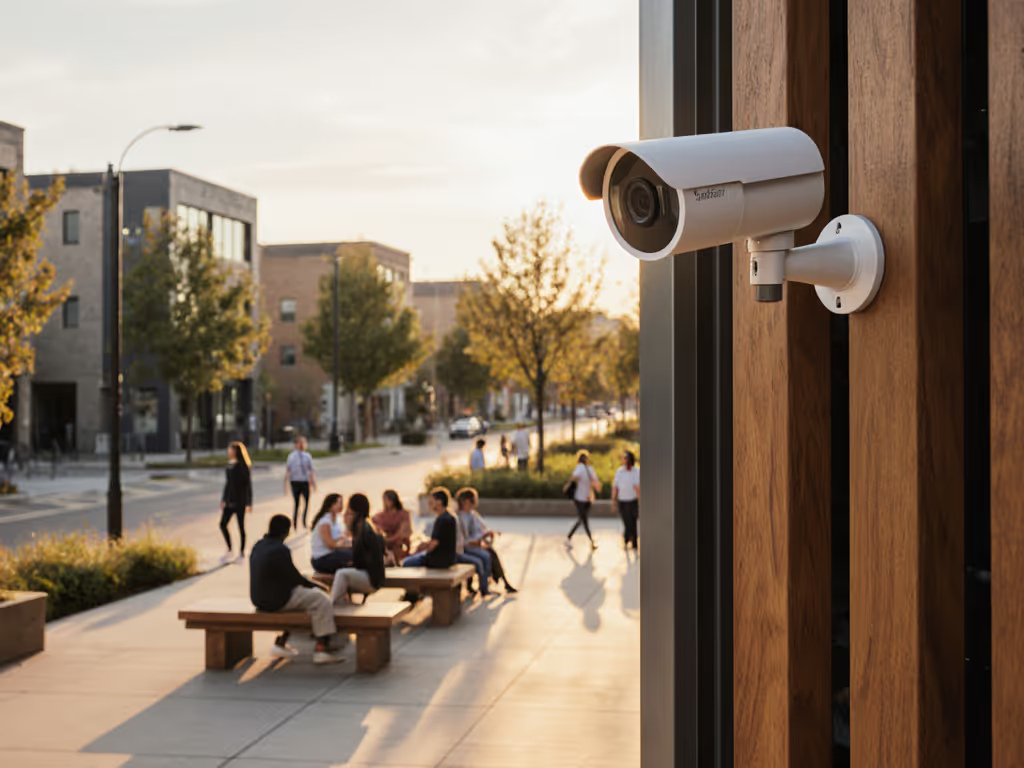
Ethical public surveillance and community AI monitoring guidelines require more than technology; they demand frameworks that align security interests with the values residents actually hold. Too often, cameras go up first and community conversation happens never, leaving neighbors unaware they are being monitored and distrust building silently. Before deployment, consider the essential questions that should precede installation, drawn from established ethical frameworks and practical governance models.
Why Ethical Frameworks Matter Before Installation
What makes surveillance "ethical" in a shared community?
Ethical surveillance begins with clarity of purpose. A camera installed to prevent porch theft serves a different legitimacy calculus than one pointed into a neighbor's window. The World Health Organization has established that surveillance data should be collected only for a legitimate public health purpose, and this principle translates directly to community security: surveillance should serve a clearly stated, publicly understood objective.[1][3]
Ethical frameworks also rest on governance. Rather than surveillance as an afterthought (a reactive decision by one resident or a silent HOA vote), communities benefit from transparent governance that anticipates ethical challenges before they materialize.[1] This means written policies, community input, and documented decision-making. To evaluate governance options in practice, compare community security platforms that balance privacy and protection. Control is a feature, and part of that control is knowing why a camera exists and what happens to its data.
The deeper principle is that privacy and reliability reinforce each other. Residents who understand the surveillance policy are more likely to support it. Systems designed with privacy protections from the outset avoid the costly retrofits and community backlash that come later. I learned this directly years ago when a neighbor's doorbell footage (innocently shared in a community group) exposed faces, license plates, and routine movements on our street in a viral post. The breach wasn't malicious, just frictionless. I rebuilt my own setup around local storage, per-camera encryption, and strict retention windows. If you're weighing storage models, our cloud vs local storage guide explains privacy, cost, and outage resilience trade-offs. The result wasn't just privacy optics; it was genuine resilience. Fewer unintended copies meant fewer leak vectors.
What ethical obligations do camera operators have?
Those who deploy and manage surveillance data carry specific duties. They must:[2]
- Identify and minimize risks before systems go live. What could go wrong? Data breaches, mission creep, accidental oversharing, discrimination based on neighborhood or appearance. Mitigation should be baked in, not bolted on.
- Secure identifiable data appropriately. Encryption, access controls, and audit logs are not optional for systems capturing faces and license plates. Local-first storage with strong encryption is the highest bar; cloud systems require transparent data handling and third-party oversight.
- Disclose risks to the community. Residents should know if footage leaves their neighborhood, who can access it, how long it's kept, and what recourse exists if misuse occurs.
- Share surveillance results back to the community. Transparency reports (what events were detected, how the data improved safety, what wasn't a threat) build trust and enable collective learning.
How Should Communities Plan Surveillance Policies?
What should a transparent surveillance policy include?
A principle-based policy articulates the threat model and response proportionally. Rather than a vague "improve security," communities should specify:[1][3]
Legitimate Purpose: Define exactly what the camera addresses. Porch theft prevention? Burglary deterrence? Missing-person search cooperation? The stated purpose becomes the boundary for data use. Once cameras are in place, drift is inevitable unless the policy is explicit and enforced.
Data Collection Rules: Which areas can be monitored? Shared hallways and driveways, yes; interior windows, no. For jurisdiction-specific boundaries, see our state security camera laws guide. What metadata is captured (timestamps, location labels, anonymization zones)? Who operates the camera, and what training do they receive?
Retention and Deletion: How long is footage stored? WHO guidelines stress that data should be kept only as long as necessary.[1] A policy might specify 14 days for standard footage, 90 days for incidents flagged for investigation, and permanent deletion thereafter. This isn't just ethics; it's risk management. Older footage is a liability and a temptation for misuse.
Access and Use: Who can view footage? Under what circumstances? "Police with a warrant" is very different from "anyone on the HOA board can request clips at will." Restrict access to operators and authorized reviewers; require logging and periodic audits.
Third-Party Sharing: If footage might be shared with law enforcement, insurance, or neighbors, the policy must say so upfront. The research is clear: absent disclosure, residents feel betrayed.[3] Conversely, informed consent (even if surveillance remains in place) restores dignity and reduces resentment.
Dispute Resolution: How do residents raise concerns about surveillance? How are complaints handled? A mechanism for accountability is non-negotiable; it's the difference between governance and imposition.
How should communities involve residents in surveillance decisions?
The WHO guidelines affirm that the values and concerns of communities should be taken into account in planning, implementing, and using data from surveillance.[1] This is not rhetorical. Practical steps include:
- Advance notice and consultation: Before cameras go up, present the proposal, threat model, and policy to affected residents. Solicit questions and objections. Document the feedback and explain how it shaped the final design.
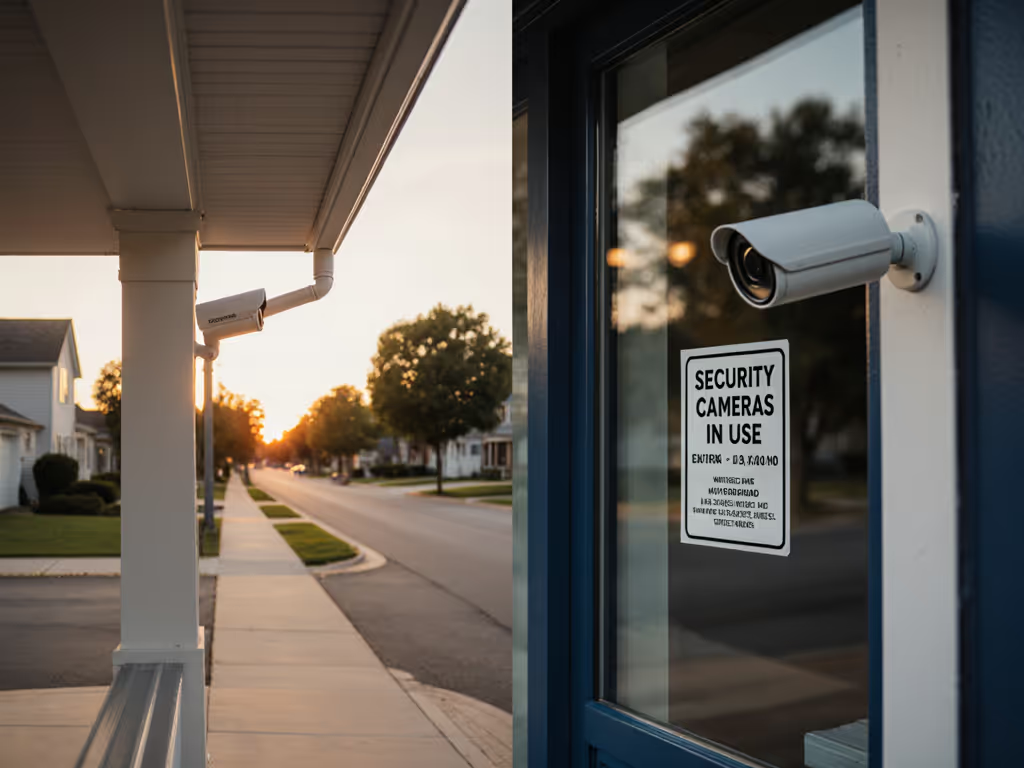
- Clear signage: Visible notices that surveillance is in place, who operates it, and how to contact operators. People have a right to know they are monitored.
- Regular review: Surveillance policies should be revisited annually. Are cameras effective? Have they been misused? Have residents' concerns shifted? Iteration signals respect.
- Data transparency reports: Publish aggregate statistics on what was captured, how many incidents, and action taken. This builds trust without compromising privacy.
Technical Design for Ethical Surveillance
How does on-device AI reduce ethical risk?
AI systems that run locally (analyzing video on the camera or NVR itself rather than uploading clips to the cloud) reduce data exhaust substantially. See how on-device AI cameras compare to cloud-reliant models for privacy and false-alert reduction. This aligns with a core principle: collect less, control more. Collect the raw video, perform detection on-device, and flag only alerts. The bulk of footage never leaves the premises.
On-device detection also reduces false alerts and notification fatigue, which improves community relations. Fewer nuisance alarms mean fewer irritated neighbors and lower risk of false-alarm fines or dispatch abuse. The trade-off is that on-device AI is less flexible than cloud models and requires stronger local compute, but for community surveillance, that's a feature. It locks the system to its intended purpose and prevents silent repurposing.
What role does encryption play in trust?
Encryption is how operators prove they mean what the policy says. If data is encrypted end-to-end, stored locally, and inaccessible even to the manufacturer, then mission creep and unauthorized access become technically infeasible. This is not theoretical; it's a risk-to-control mapping. Without encryption, the promise of limited retention or access is only as strong as the operator's integrity and competence. With encryption, the promise is structural.
Communities should require that operators publish their encryption approach: algorithm, key management, and how often keys are rotated. Vagueness is a red flag. For concrete hardening steps that match these promises, follow our camera hacking prevention guide.
Addressing Common Objections
Can surveillance really reduce inequality in a community?
Yes, but only with careful framing. WHO guidelines note that surveillance can make visible "pockets of suffering that are unfair, unjust and preventable."[4] In community context, this means that residents in higher-crime areas, older buildings, or less-resourced neighborhoods can access evidence of crimes against them without needing personal cameras. Shared infrastructure democratizes protection.
However, surveillance can also entrench inequality if it is visible in wealthy areas and absent in others, or if it targets certain residents more intensely. Ethical policy must attend to equitable deployment and protection against discriminatory misuse. This is not optional; it is part of the legitimate purpose check.
Does ethical surveillance require informed consent?
Not in the way many assume. WHO guidance holds that individuals have an obligation to contribute to surveillance when reliable data is required and appropriate protections are in place; informed consent is not ethically required in all cases.[1] However, this presumes robust protections and transparent policy. In community contexts, this means residents may not need to consent to a camera in a shared hallway, but they absolutely must be informed it exists, told what it captures, and given recourse if misused.
Moving Forward: A Principle-Based Checklist
Before a community deploys surveillance, verify:
- Purpose is clear and documented. Not vague security theater.
- Governance is transparent and inclusive. Residents are consulted, objections are heard, and decisions are recorded.
- Data design minimizes collection. Local storage, on-device processing, strict retention, and encryption by default.
- Access is restricted and audited. Logging, restricted operators, and periodic review.
- Sharing policy is explicit. Especially regarding law enforcement, and with resident knowledge.
- Accountability mechanisms exist. Dispute resolution, regular policy review, and transparency reporting.
- Signage is clear and visible. No hidden surveillance.
Ethical surveillance is not about abandoning security; it is about securing data the way you secure evidence, with integrity, clarity, and respect for those involved. Communities that invest in this upfront build systems that are genuinely trustworthy and resilient to the politics and privacy violations that derail less thoughtful deployments.
Related Articles