Retail People Counting Cameras: Accuracy & Privacy Compared
By Aoife O'Connell • 3rd Mar
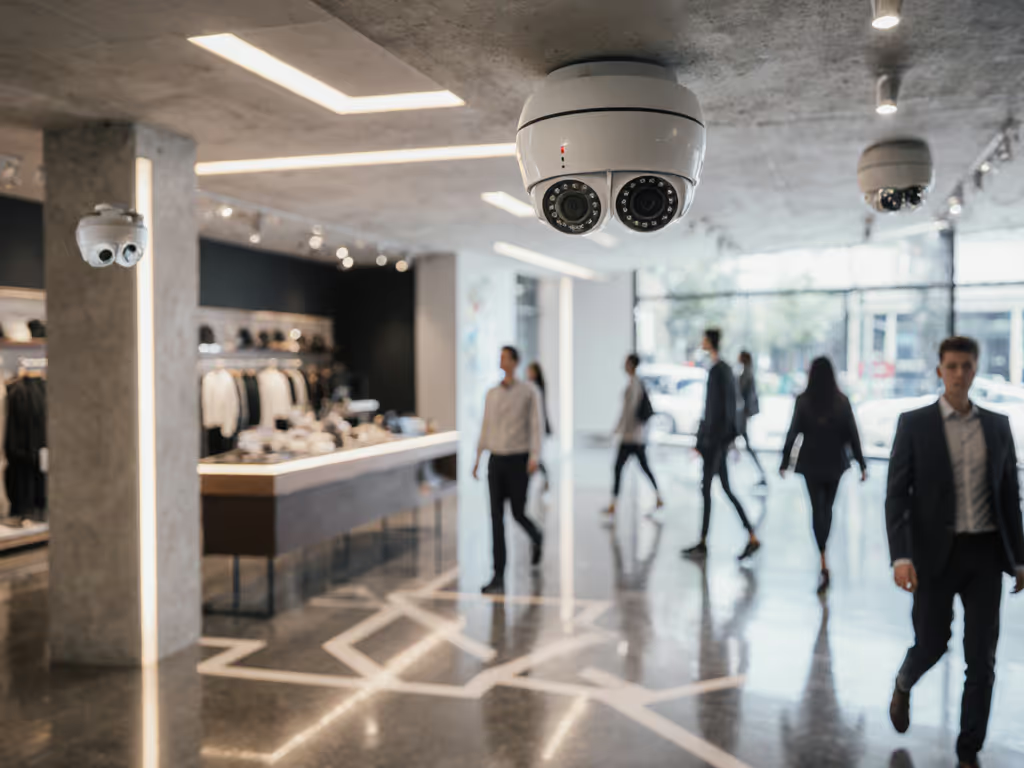
If you've installed people counting cameras in a retail space or are thinking about it, you've likely noticed how wildly accuracy claims vary. One vendor promises 99%, another claims 98%, and you're left wondering which technology actually delivers (and whether it's worth the privacy trade-off). Retail people counting security cameras have become central to understanding customer traffic and optimizing store performance, but their real-world reliability depends far more on technology choice and proper placement than marketing percentages suggest. Let's cut through the noise. For turning people-counting data into actionable merchandising and staffing insights, see our retail security analytics guide.
Why Does Accuracy Actually Matter?
Q: What's the real difference between 95% and 99% accuracy in people counting?
It sounds like only a 4-point spread. In practice, it's transformative. Consider a busy retail location with 2,000 visitors per day. At 95% accuracy, you're missing 100 people daily, roughly equivalent to your peak occupancy threshold. At 99% accuracy, you're missing 20. That margin changes whether your conversion reports are ballpark estimates or genuinely actionable data.
Accuracy matters most when you're using the data for compliance, capacity management, or staffing decisions. A marginal miss on foot traffic becomes a compounding error on your key performance indicators. The difference between accuracy levels also reveals something important: not all measurement methods are created equal.
How Do People Counting Technologies Actually Work?
Q: What's the difference between stereo-video, thermal, and AI-enhanced systems?
Three dominant technologies power most retail people counters today:
Stereo-Video: Uses dual lenses to capture depth information and create a three-dimensional view of movement. It consistently achieves 98% or higher accuracy because the dual-lens approach allows the system to distinguish actual people from shadows, shopping carts, or other moving objects. The downside? Stereo systems require good lighting and clear sightlines. Install one pointing into harsh backlighting or reflective surfaces, and accuracy drops fast (much like how a driveway camera mounted on a wobbling bracket loses clarity even when the sensor is premium). To understand how lighting shifts affect analytics, see our lighting accuracy comparison.
Thermal Imaging: Detects heat signatures rather than visual detail, making it well-suited to total-darkness environments like theaters or loading zones. Thermal typically achieves around 85% accuracy because it can't distinguish between closely packed people, often counting groups as single entities. However, thermal struggles in warm environments and loses precision at higher ceiling heights.
AI-Enhanced Stereo: Combines stereo hardware with machine learning to filter out false positives (strollers, mannequins, unusual postures) that once caused errors. By 2027, industry data suggests these systems will consistently achieve 99% accuracy as AI models accumulate more real-world training data. Leading vendors like Axis achieve 97-98% accuracy in retail spaces, while FOORIR's 3D depth sensing hits 98% in high-traffic zones.
The practical takeaway: stereo-based systems, especially those enhanced with AI, are the gold standard for indoor retail. Thermal is a specialized tool for edge cases, not your everyday people counter.
What About Privacy? Can You Even Use These Ethically?
Q: Do people counting cameras create privacy issues? What's the legal angle?
This is where honesty matters. Generic CCTV cameras repurposed for people counting raise real concerns: they're not designed for counting, they can't properly anonymize subjects, and they often require GDPR-compliant processing to avoid legal liability. Multiple cameras at different angles multiply the privacy footprint.
Dedicated people counting sensors, especially stereo and thermal systems, work differently. Stereo-video sensors analyze movement patterns and body dimensions without capturing facial detail or recording identifiable images. Thermal systems don't record video at all; they record heat signatures. The distinction is critical: a system designed from the ground up to count anonymously is fundamentally lower-risk than a video camera doing double duty.
Best practice: Use dedicated people counters in high-traffic areas, pair them with clear signage that customers are in a monitored zone, and ensure your data retention policy is transparent. For placement boundaries and consent rules by state, review our legal placement guide. If privacy is a cornerstone concern, thermal or anonymized stereo systems beat CCTV every time.
How Do You Measure Accuracy in the Real World?
Q: These specs all look good on paper. How do I know if a system actually works in my space?
Vendors determine accuracy through post-installation audits: they manually count people from recorded video during a set period, then compare those counts to what the system recorded. The gap is your accuracy percentage. But here's the catch: not all audits are equal. Some test in pristine conditions; others test during peak chaos.
When evaluating a system, ask three questions:
- What were the test conditions? Peak hour? Off-peak? Rainy day? High-traffic entrance or a quieter aisle?
- What's the field of view? A narrow beam covers 15 square meters; a wide field covers 100. Wider isn't always better if it sacrifices depth precision.
- How often is accuracy validated post-installation? RetailNext, for example, guarantees a minimum 95% accuracy threshold and conducts systemic health monitoring with automatic escalation for anomalies.
Solid mounts and clean power beat fancy features. A system installed haphazardly will underperform no matter what the spec sheet promises. Ensure mounting brackets are rigid, wiring is protected, and the sensor has a clear, unobstructed view of the counting zone.
What About RGB Cameras vs. Specialized Sensors?
Q: Can I just use a standard IP camera with AI software for people counting?
Technically, yes. RGB cameras analyze visual data and can differentiate between people and other objects. They work reasonably well in retail stores where visual identification is useful. But they carry trade-offs:
- Performance varies with lighting: RGB cameras struggle in backlighting, glare, or low-light scenarios. A window with direct sunlight or a reflective floor can confuse the algorithm.
- Occlusion problems: Groups clustered together are often counted as one person, especially if parts of the group are obscured.
- Storage overhead: RGB video requires far more storage bandwidth than depth-based or thermal data.
If you need additional context, like understanding which products customers linger near or whether they're alone or in groups, RGB makes sense. For pure accuracy in high-density foot traffic, stereo-video wins.
Placement & Configuration: Where the Real Accuracy Lives
Q: Does it really matter where I mount the sensor?
Absolutely. I've seen a family's driveway camera miss everything because the mount wobbled and Wi-Fi dropped (until we rewired to PoE, added a wedge, and aimed past the glare). False alerts fell, plates popped at night, and the house finally stopped buzzing every breeze. The same principle applies to retail people counting.
Critical placement factors:
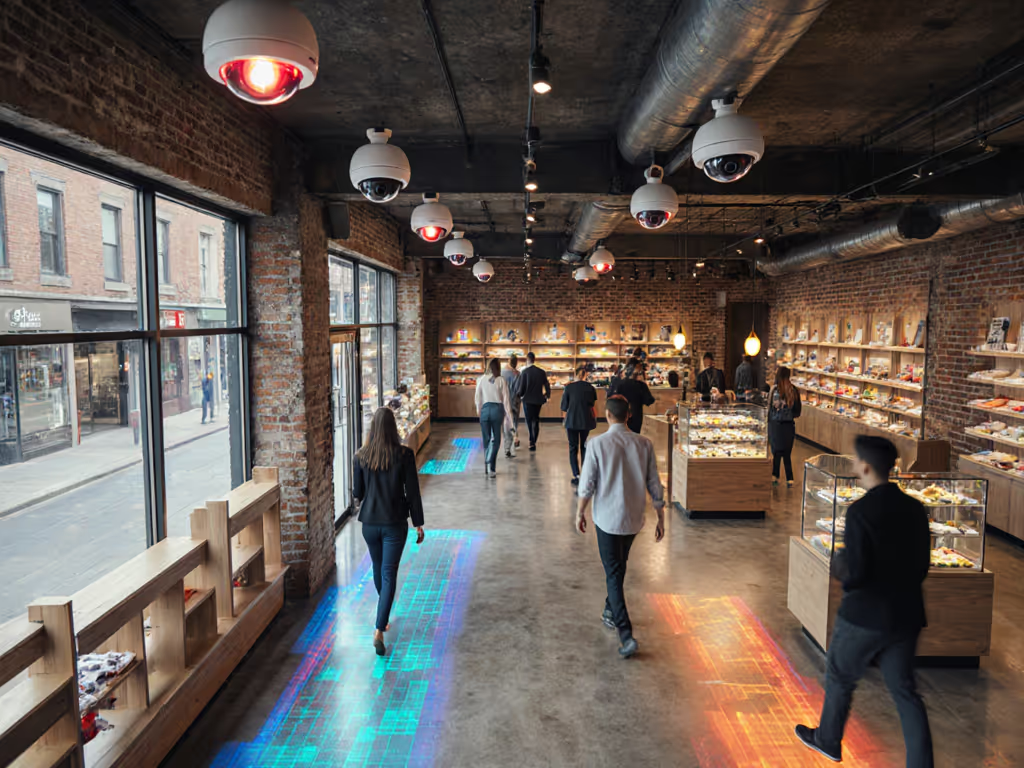
- Height: Most stereo-video systems perform best when mounted at 7-9 feet, perpendicular to traffic flow. Too low, and tall shoppers block shorter ones. Too high, and the depth perception loses precision.
- Angle: Aim the sensor to capture the full width of your target zone, entrances, checkout lines, aisles, without backlighting or strong reflections.
- Power: Use PoE (Power over Ethernet) wherever possible. It eliminates battery anxiety, ensures consistent uptime, and allows firmware updates without physically accessing the sensor. Wireless sensors struggling with intermittent connectivity will never deliver reliable counts. For a deeper look at connection trade-offs, see our wired vs wireless comparison.
- Calibration zones: Define counting boundaries in software to exclude restrooms, storage, or adjacent retail spaces. Good systems let you configure up to five zones per sensor.
Let's fix the basics first. A mediocre sensor mounted correctly and powered reliably will outperform a premium system fighting Wi-Fi dropout and vibration.
What's the Financial Reality? Subscription Creep?
Q: How much does this cost, and are there hidden fees?
Dedicated people counting systems range from $800 for entry-level thermal sensors to $3,000+ for enterprise stereo-video with AI. But that's the hardware price.
Some vendors bundle analytics and reporting into subscription tiers: $50-200 per month for cloud storage, advanced dashboards, or integration with POS systems. Ask upfront:
- Is accuracy reporting included, or is it a premium feature?
- Can data live locally on an NVR, or is cloud mandatory?
- Are firmware updates free, or do major features require re-licensing?
Transparent vendors publish their total cost of ownership. If a quote doesn't include subscription, support, and storage costs, dig deeper.
Actionable Next Steps: Choose and Deploy
Here's how to move forward:
Step 1: Define your primary use case. Are you optimizing staffing based on traffic? Measuring conversion? Compliance reporting? Each use case has different accuracy thresholds.
Step 2: Audit your environment. Visit your target location during peak and off-peak hours. Note lighting conditions, foot-traffic density, and potential obstructions. This informs your technology choice.
Step 3: Request a pilot deployment. Most quality vendors will install a single sensor on a trial basis. Run a two-week test and manually validate counts. Compare the system's data to your manual audit. Accuracy below 95% in your real conditions is a red flag.
Step 4: Plan for wired power. If the deployment location supports PoE, use it. It eliminates connectivity headaches and maximizes uptime. If not, invest in industrial-grade uninterruptible power supplies to protect against brief outages.
Step 5: Document your privacy stance. Decide whether your data stays local or moves to the cloud. Not sure which storage path fits your risk and budget? Start with our cloud vs local storage guide. If cloud, enforce encryption in transit and at rest. Post signage in customer-facing areas.
Step 6: Integrate with your existing tools. Ensure the system connects to your POS, property management software, or business intelligence platform. Siloed data is data you won't act on.
Retail people counting accuracy is the intersection of technology, placement, and disciplined configuration. Choose stereo-video or AI-enhanced systems for indoor retail; validate accuracy in your actual environment; use wired power and clear mounting; and stay skeptical of vendors who claim 99% without showing methodology. Reliability isn't a feature, it is build quality. And that's what yields counts you can trust.