Retail People Counting Cameras: Accuracy Compared
By Kojo Mensah • 4th Apr
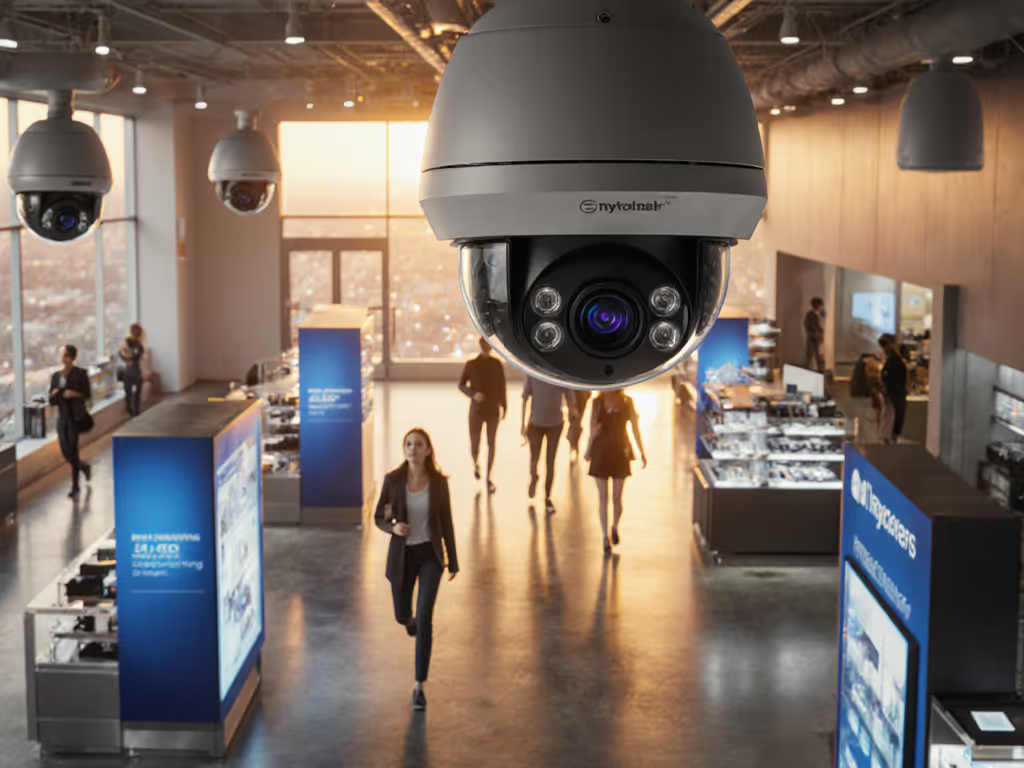
Retail people counting security cameras and customer traffic analytics have become essential tools for retail operations, yet the landscape of counting technologies presents meaningful trade-offs in accuracy, implementation, and (critically) data control. Unlike the frictionless sharing that once exposed my neighbor's doorbell footage to an entire online community, modern retail operations must balance operational insight with deliberate data governance. The choice between counting methodologies determines not only how reliably you measure foot traffic, but also what data persists, where it lives, and who controls it.
How Do Different People Counting Technologies Actually Work?
RGB Camera-Based Counting Systems
RGB (Red-Green-Blue) camera-based people counting systems capture standard color images and apply image processing algorithms to detect and count individuals. These systems work by analyzing visual data to differentiate between people, objects, and environmental features, making them particularly useful for indoor retail environments. The fundamental advantage is their ability to analyze facial features and body postures, improving accuracy in dynamic retail settings.
However, this capability comes with an accuracy ceiling. RGB systems perform well under optimal lighting conditions but can be significantly affected by variable illumination, shadows, and occlusions (a customer partially blocked by a display stand, for instance, may be miscounted or skipped entirely). Their medium-to-high accuracy profile makes them suitable for moderate foot traffic areas, but they perform less reliably in crowded peak hours or dimly lit zones.
Monocular vs. Binocular Vision Approaches
Within camera-based systems, two distinct approaches exist. Monocular technology uses a single-lens camera with AI-based object detection to estimate depth and count people. This approach is cost-effective and lightweight, but it carries inherent limitations: a single lens struggles to distinguish foreground from background in complex scenes, leading to accuracy degradation in crowded environments.
Binocular technology, by contrast, employs dual-lens cameras to capture stereo depth information. This dual-lens approach offers enhanced depth perception and better differentiation between overlapping individuals, resulting in improved accuracy even when foot traffic peaks.

2D Monocular Counters
2D monocular counters operate with a single camera lens installed overhead to detect moving objects. The counting algorithm digitally removes static background elements and tracks only moving objects crossing a defined threshold. This approach is straightforward and requires minimal computational overhead, but accuracy depends entirely on clean object detection. Any movement not clearly distinguishable from the environment introduces counting errors.
3D Stereo Vision Counters
3D stereo vision technology represents a significant leap in accuracy. By processing two separate images captured simultaneously and combining them to extract three-dimensional spatial information, stereo vision mimics human binocular depth perception. Modern 3D stereo counters integrate AI algorithms to enhance object detection and filtering, achieving accuracy rates of 95-98% in most conditions.
The critical advantage of 3D stereo systems is their ability to exclude objects that do not meet specified height requirements during calibration. A shopping cart, fallen item, or pet cannot be miscounted as a person when the system has established clear spatial parameters.
3D Active Stereo Vision - The Highest Accuracy Tier
3D active stereo vision extends stereo capabilities by projecting enhanced modules onto the monitored area to generate depth information even in complete darkness. This technology processes combined images to create depth maps, achieving accuracy rates up to 99% with AI enhancements. Sensors are installed on the ceiling to monitor entrance points, and the approach performs consistently across lighting conditions, a critical advantage in retail environments with variable illumination.
What About Traditional People Counting Sensors?
Thermal Sensing
Thermal sensors detect body heat emitted by people and count individuals in a given area. This approach is inherently privacy-preserving (thermal imaging produces no facial features or identifying characteristics), but it offers limited behavioral insight. You receive a count, but not directional data, dwell time, or path analysis.
Radar-Based Detection
Radar-based people detection operates in low-visibility conditions and achieves very high privacy ratings because it produces no visual data whatsoever. However, radar struggles to differentiate between multiple individuals standing close together, making it less reliable in dense retail environments.
Accuracy in Practice: What Matters Most?
The Directional Advantage
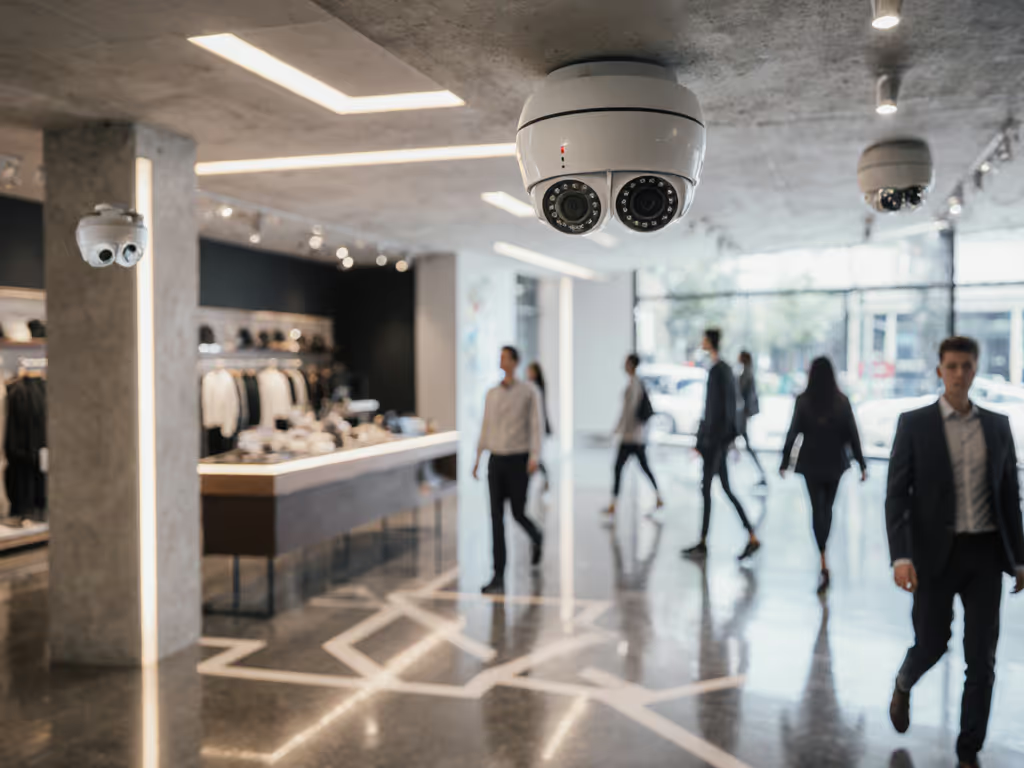
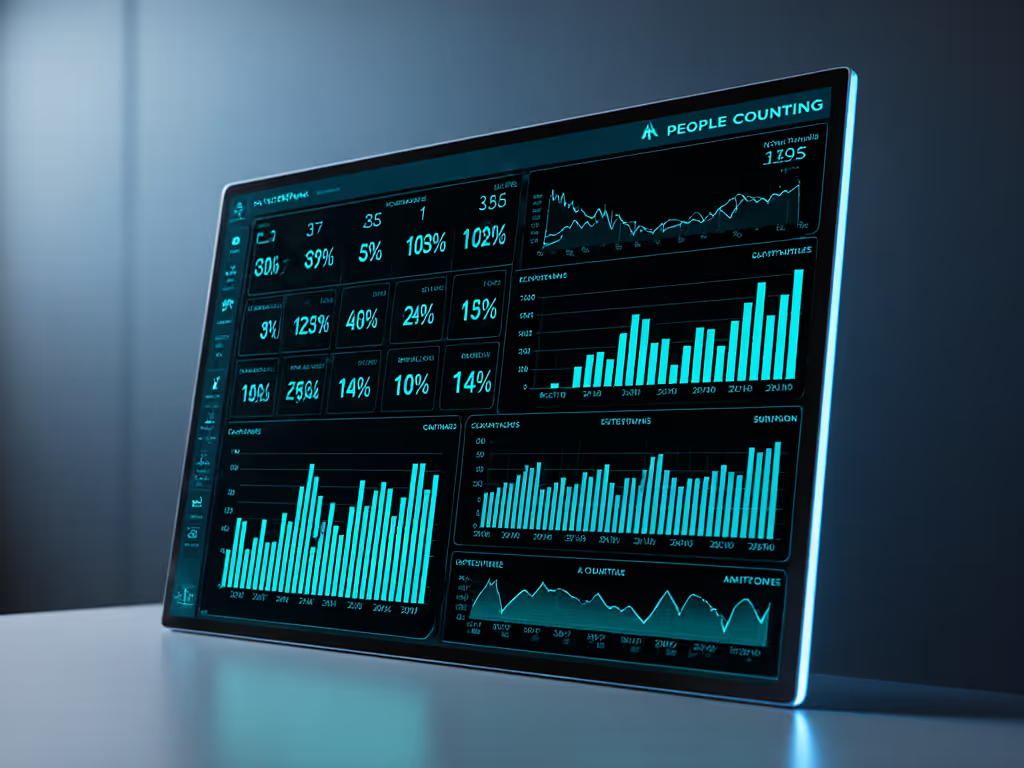
Camera-based systems, particularly those using virtual threshold lines, provide directional tracking: they count entries separately from exits. This distinction is foundational to understanding store occupancy and conversion metrics. To turn these counts into actionable layout and staffing changes, read our retail security analytics guide. When Videoloft's algorithm tracks an individual crossing a defined line at the doorway, it records direction and adds the count to a real-time occupancy counter. Thermal and radar systems typically cannot achieve this level of behavioral granularity.
Multi-Level Data Depth
The most sophisticated camera-based systems enable analysis at multiple temporal scales. You can examine long-term seasonal patterns across a year, analyze weekly foot traffic trends, or zoom into hourly variations throughout a single day. However (and this is where data governance becomes critical), this granular data must be managed intentionally.
Camera Placement and Accuracy Trade-offs
Accuracy is not merely a function of technology; it depends entirely on implementation. Optimal placement requires:
- Full visibility: Position the camera so the entire entrance or exit is visible, ensuring the full height of each person is captured
- Minimal obstructions: Avoid displays or barriers in front of the counting line that block people crossing
- Proximity: Maintain camera distance of less than 12 feet (3.5 meters) from the count line
- Optimal angle: Position the camera so the angle from the count line to the camera is no more than 50 degrees
- Adequate illumination: Maintain consistent lighting on both sides of the line for clear visibility
- Strategic placement: Avoid positioning count lines where people typically stand or linger, as stationary individuals affect count accuracy
These requirements reveal a principle-based approach: accuracy is inseparable from operational design. A 99% accurate system installed poorly will underperform a 95% accurate system optimally placed.
Privacy and Data Control: The Missing Conversation
Retail operators and property managers face a structural tension: people counting requires visual or sensory data capture, and that data represents leverage. Unlike thermal or radar approaches, camera-based systems preserve enough visual information to enable identification, tracking across multiple frames, and behavioral analysis.
Collect less, control more; privacy is resilience when things go wrong.
This principle applies directly to retail analytics. Every system generates data exhaust (footage, heatmaps, behavioral patterns) that creates liability if mishandled. Techniques like differential privacy can preserve aggregate insights while minimizing exposure to identifiable data. The question is not whether to count people, but whether your counting system is designed to minimize what it retains, where it routes that data, and who can access it.
Implementations that link every data point to actual footage (as some advanced systems do) enhance verification but also create comprehensive behavioral records. If that footage is cloud-stored without encryption, shared with third parties, or retained indefinitely, the accuracy gain comes at the cost of control. A robust implementation uses local storage with on-device processing, exports directional counts without storing raw video, and maintains clear retention policies. For a deeper comparison of reliability and costs, see our cloud vs local storage guide.
Control is a feature. It shapes not only privacy posture but operational resilience: systems that depend on cloud connectivity for basic counting will fail when internet drops, whereas systems with local processing continue operating and queue data for later sync.
Comparing Accuracy Across Deployment Scales
| Technology | Typical Accuracy | Best Use Case | Key Limitation |
|---|---|---|---|
| RGB camera (standard) | 80-90% | Moderate traffic, good lighting | Affected by occlusions and shadows |
| Monocular AI | 85-92% | Single-lane entry, low complexity | Struggles with overlapping individuals |
| 2D monocular counter | 75-85% | Simple threshold detection | No depth information, high false positives |
| 3D stereo vision | 95-98% | Retail environments, variable crowds | Requires stereo calibration and optimal placement |
| 3D active stereo vision | 98-99% | High-accuracy requirement, poor lighting | Higher cost and computational overhead |
| Thermal sensors | 85-95% | Privacy-critical environments | No directional or behavioral data |
| Radar | 80-90% | Low-light, high-privacy zones | Poor performance with close-proximity crowds |
What Should Drive Your Technology Choice?
Accuracy alone is insufficient. The decision framework should account for:
Threat model: What are you optimizing for? Conversion rate analysis requires directional data and dwell time. Queue management needs real-time occupancy. Privacy-sensitive environments require non-visual detection. Each goal maps to different technologies.
Data governance: Where will counting data live? Will it integrate with your existing infrastructure or depend on cloud storage? Can you export the data, or are you locked into a vendor's dashboard?
Implementation constraints: What is the camera angle at your entrance? Can you mount overhead, or must you use wall-mounted approaches? Does your lighting vary significantly throughout the day?
Operational resilience: If the system fails, can your business continue? Local-first systems degrade gracefully; cloud-dependent systems go dark.
Total cost of ownership: Accuracy comes at a price. A 99% solution costs significantly more than a 95% solution. Is the 4% difference worth the investment for your specific application?
Emerging Considerations: AI Enhancement and Accuracy Claims
Modern people counting systems increasingly incorporate AI-driven object filtering and behavior classification. These enhancements can improve accuracy by distinguishing between people, shopping carts, strollers, and animals. However, such claims should be evaluated against published testing methodology, not marketing assertions. Accuracy figures without disclosed test conditions (lighting, crowd density, camera angles) are promotional, not technical.
How to Evaluate Accuracy Claims
When comparing systems, demand specificity:
- Test conditions: Under what lighting, crowd density, and camera configurations was accuracy measured?
- Verification method: How was accuracy validated (comparison to manual counts, ground truth footage, or third-party testing)?
- Edge cases: How does the system perform under the specific conditions of your retail environment (narrow aisles, seasonal lighting changes, peak traffic)?
- Failure modes: What causes the greatest accuracy degradation? Where does the system acknowledge its limitations?
- Data retention: Is every count permanently logged with video, or are counts aggregated and raw footage deleted? This distinction matters for your liability profile.
Practical Guidance for Retail Operators
If your primary goal is staffing optimization and occupancy monitoring, a 3D stereo vision system (95-98% accuracy) with directional tracking typically provides the best balance of accuracy and operational insight at reasonable cost.
If your environment features variable or poor lighting, active stereo vision (98-99% accuracy) justifies the higher expense.
If your requirement is privacy-first detection (e.g., sensitive zones within retail, or compliance with strict data minimization policies), thermal or radar approaches, despite lower accuracy, may align better with your governance model.
Regardless of technology choice, ensure local processing and storage where feasible. Systems that process counts on-device, retain only aggregated metrics, and avoid unnecessary cloud dependencies create fewer security and privacy surface areas.
Looking Forward: Standards and Interoperability
Retail analytics is increasingly fragmented across proprietary platforms. As you evaluate people counting solutions, prioritize systems that export data in standard formats (CSV, JSON) and follow open standards like RTSP or ONVIF for video streams. Vendor lock-in today becomes a compliance headache tomorrow.
Further Exploration
Accuracy comparison reveals that people counting is not a single technology but a spectrum of approaches, each with trade-offs between precision, cost, privacy, and operational complexity. To deepen your evaluation:
- Test systems in your actual retail environment under peak traffic conditions. Vendor demos under controlled conditions rarely reflect real-world performance.
- Request detailed accuracy reports that specify test conditions and edge cases, not just headline percentages.
- Map your data governance requirements before selecting technology. Accuracy without control creates risk.
- Consult with IT and compliance teams about data retention, encryption, and cloud dependencies early in the selection process.
- Start with a pilot deployment on a single entrance before scaling. Real-world performance informs full rollout decisions.
The right people counting system is the one that delivers the accuracy you need, in the format you control, at a cost aligned with the business value it generates. Choose deliberately.
Related Articles