Public Transit Security Cameras: Compared
By Aoife O'Connell • 23rd Feb
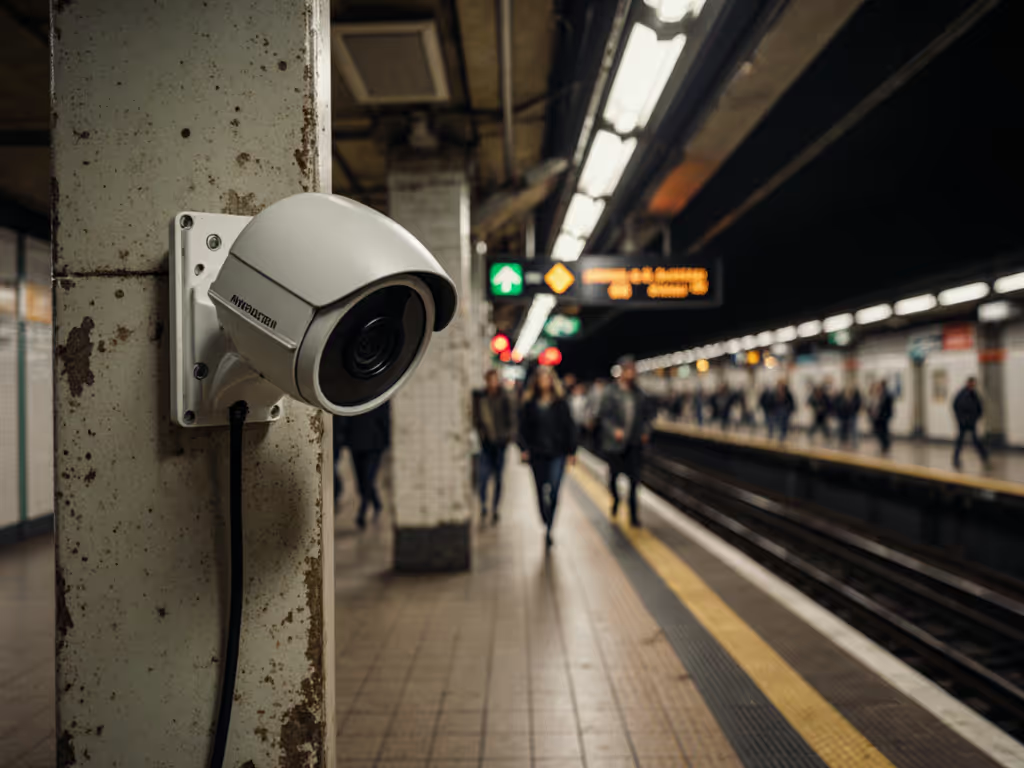
If you manage a fleet, oversee a transit facility, or simply want to understand why public transportation surveillance works the way it does, public transportation security cameras represent one of the most proven and reliable systems in operation today. Unlike consumer home cameras, transit system surveillance operates under different constraints: continuous duty cycles, extreme environmental demands, and the need for evidence that holds up in court. Let's fix the basics first and understand how these systems compare, what makes them effective, and what you can learn from their design principles.
Why Transit Agencies Deploy Cameras in the First Place
What Problem Are They Solving?
Transit agencies face a unique set of challenges: passenger safety, driver protection, liability reduction, and the need to resolve incidents quickly with irrefutable evidence. The scale is enormous: Chicago's transit authority alone operates thousands of buses, each equipped with upwards of 12 cameras depending on the model, a practice they've maintained since 2003.[7]
False claims, assaults, and accidents happen. Without video evidence, agencies are left guessing. With it, they can identify exactly what occurred, in what sequence, and who was responsible. That's not surveillance theater; that's operational necessity.
What Does "Proven" Actually Mean?
Safe Fleet operates over 1 million video systems in mission-critical fleets across North America.[1] That's the scale we're talking about. These aren't experimental systems. They've been refined through thousands of real-world incidents, court cases, and operational adjustments. The camera placement, power architecture, and recording strategy reflect decades of learning.
How Transit Surveillance Systems Are Built
The Core Components
Every transit surveillance system has three fundamental pieces:
Cameras positioned strategically around the vehicle (interior, front, rear, and sides). High-definition, tamper-proof, and water-resistant, they're built for mobile environments where vibration, temperature swings, and humidity are constant challenges.[1]
Digital Video Recorders (DVRs) or Mobile DVRs that handle 4 to 16 camera channels simultaneously, recording video, audio, and vehicle telemetry (GPS, speed, harsh braking events, turn signals).[1] This metadata layer is crucial: it synchronizes what happened on camera with what the vehicle was actually doing.
Connectivity that ranges from onboard storage (solid-state drives or SD cards) to live transmission. Many systems now include integrated GPS, Wi-Fi, and 4G options, allowing real-time monitoring and remote footage access.[4]
Solid mounts and clean power beat fancy features.
The reason transit systems are so reliable isn't that they have more sensors than a home camera. It's that they obsess over two things: mounting stability and electrical architecture.
The Power Difference: Why PoE and Hardwired Systems Matter
Home camera systems often struggle with power management: battery drain in cold weather, missed events while charging, Wi-Fi dropout during peak usage. For a reliability-focused comparison of connection and power options, see our wired vs wireless cameras breakdown. Transit systems sidestep this entirely by using wired infrastructure.
Many transit backup camera and safety systems use industrial-grade wiring, with power and data delivered through the vehicle's electrical backbone. Some integrate with the bus's onboard power system, ensuring continuous recording even during driver shifts or maintenance windows.
This isn't a luxury choice. It's a reliability choice. When a system is always powered and always connected, there's no buffer for human error. The camera doesn't miss because someone forgot to charge it. It doesn't drop frames because the Wi-Fi flaked during a collision.
Comparing Camera Placement Strategies
Interior Coverage
Inside the bus, cameras are positioned to capture passenger interactions, assaults, or accidents. The quality and clarity of this footage allow staff to identify even subtle non-verbal cues (gestures, confrontations, medical emergencies) with incredible detail.[1]
Blind Zone Reduction
This is where placement strategy becomes critical. Transit buses have massive blind zones (the area a driver can't see from mirrors alone). Research by the U.S. Department of Transportation showed that a camera-based system with a 60-degree lens reduced blind zones by 64% compared to mirrors alone, and a 100-degree wide-angle lens could eliminate blind zones almost entirely.[5]
But here's the catch: wider lenses create distortion. Transit agencies use a hybrid approach, combining cameras with specific degree fields (often 65 degrees horizontal) alongside existing mirrors. Driver tests showed that with this hybrid system, operators achieved 96-98% accuracy in identifying object locations versus 70-78% with mirrors only, and they identified objects faster, even with additional monitor locations to scan.[5]
Placement matters more than megapixels — see our camera field of view guide for how to prevent blind spots.
Exterior and Rear Coverage
Front-facing cameras capture pedestrian interactions and road hazards. Rear and side cameras protect against liability claims and allow operators to reverse safely on crowded streets. Some systems include dedicated backup camera displays with sensor integration (obstacle detection systems that alert drivers to stationary or moving objects in the blind zone).[2]
Camera Technology: Analog vs. IP vs. AHD
Transit agencies choose between three main camera architectures:
| Feature | Analog Camera | IP Camera | AHD Camera |
|---|---|---|---|
| Cost | Least expensive | Most expensive | Mid-range |
| Video Quality | Lowest resolution | Highest resolution | Improved resolution, but not as high as IP |
| Scalability | Limited | Easiest | Moderately complex |
Analog systems are budget-friendly but offer lower resolution, making it harder to identify faces or license plates in low light.
IP cameras deliver the highest resolution and scalability (add more cameras without replacing the infrastructure), but they're more expensive and introduce network complexity. If your Wi-Fi or wired network isn't robust, you get bottlenecks.
AHD (Analog High Definition) splits the difference. Better resolution than analog, simpler integration than IP, and less cost than IP. It's why many transit agencies still use it.
The choice isn't about which is "best": it's about which matches your environment, network capacity, and evidence standards. In court, low-resolution footage loses credibility. In a fleet with inconsistent network infrastructure, IP cameras become a liability.
Data, Analytics, and the Evidence Chain
Why Metadata Matters
Modern transit surveillance doesn't just record video. It captures:
- GPS location
- Vehicle speed and acceleration
- Braking events
- Turn signals and steering input
- Timestamp and date (synchronized across all cameras)
When multiple views and vehicle data are displayed on one screen, transportation managers get a complete incident reconstruction.[1] To keep footage admissible and useful, follow our police evidence submission guide. A passenger claims the driver hit the brakes too hard and caused them to fall. The video shows what happened, but the telemetry shows the exact g-force of the braking event, the vehicle's speed, and whether it was harsh compared to normal operation.
Reporting and Analysis
Some transit systems now integrate advanced data reporting. Route capacity planning, live occupancy counts, passenger boarding and alighting matched with GPS and timestamps: this creates an audit trail that's useful for scheduling, safety analysis, and compliance.[4]
Blind Spots in Consumer Comparisons
What Consumer Reviews Miss
When homeowners evaluate security cameras, they focus on battery life, app responsiveness, and nighttime color capture. Transit agencies focus on something different: mean time between failures (MTBF), tamper resistance, and whether footage is admissible in court.
A home camera that misses an event because of a Wi-Fi dropout is a pain. A transit camera that misses a collision because of a power glitch is a liability exposure. The engineering priorities are completely different.
The Anecdote Nobody Talks About
Consider a family who installed a driveway camera. It looked great in daylight marketing photos, but in real use, the mount wobbled when trucks passed, Wi-Fi dropped during peak hours, and the infrared light reflected off a white wall, washing out nighttime footage. False alerts piled up from headlights and trees. Plates were invisible after dark.
They rewired to a hardwired architecture with PoE power, added a wedge to stabilize the mount, and repositioned the camera to aim past the glare. False alerts fell by 70%. License plates popped at night. The house finally stopped buzzing every breeze.
Transit agencies learned this lesson decades ago. They don't rely on wireless for critical systems. They don't assume a white surface is a good backdrop for IR. They mount cameras with industrial-grade brackets. Solid mounts and clean power beat fancy features, and that wisdom applies everywhere.
Actionable Takeaways for Property Managers and Fleet Operators
1. Placement First
Don't buy the camera that has the best specs. Buy the camera that fits the physical realities of your space. Where are your blind zones? What surfaces will reflect infrared light? What angles will a driver actually scan? Answer these questions before you choose hardware.
2. Power Architecture
If it's a permanent installation, run PoE or hardwired power. Wireless and battery-powered cameras are convenient for renters and flexibility, but they introduce failure modes that wired systems eliminate. Continuous duty, consistent performance, and reliable evidence require clean, always-on power.
3. Metadata and Synchronization
Video alone isn't always enough. Can your system sync timestamps across cameras? Does it capture vehicle telemetry (speed, acceleration, GPS location)? This metadata layer is what transforms raw video into actionable, court-ready evidence.
4. Redundancy and Recovery
Transit systems don't assume networks are perfect. They buffer video locally, test failover procedures, and verify that cameras continue recording if the network goes down. Plan for the same. To harden against outages and improve retrieval, compare cloud vs local storage approaches.
5. Resolution vs. Environment
Resolution matters, but only if your image doesn't get washed out by glare, reflection, or low light. A 1080p camera with bad placement and harsh IR reflection is useless. A 720p camera with ideal placement and tuned lighting is evidence-grade. For choosing resolution that actually improves identification, see our 1080p vs 4K guide.
Final Thoughts: Reliability Is Built, Not Bought
Public transit security cameras work because they're engineered for reality, not marketing specs. They're wired, not wireless. They're mounted solidly, not flexibly. They capture metadata, not just pixels. And they're continuously updated and maintained, not left to rot on a firmware version from three years ago.
You don't need a 16-camera transit DVR to protect a small property. But you do need the same philosophy: fix the basics first, get the placement right, run clean power, choose resolution that matches your environment, and capture evidence that matters. Everything else is noise.
Start by mapping your blind zones, identifying where you absolutely need coverage, and asking what your system needs to prove. Build from there. That's how transit agencies do it, and it's why their systems last.
Related Articles