Differential Privacy: Video Analytics Without Surveillance
By Kojo Mensah • 31st Mar
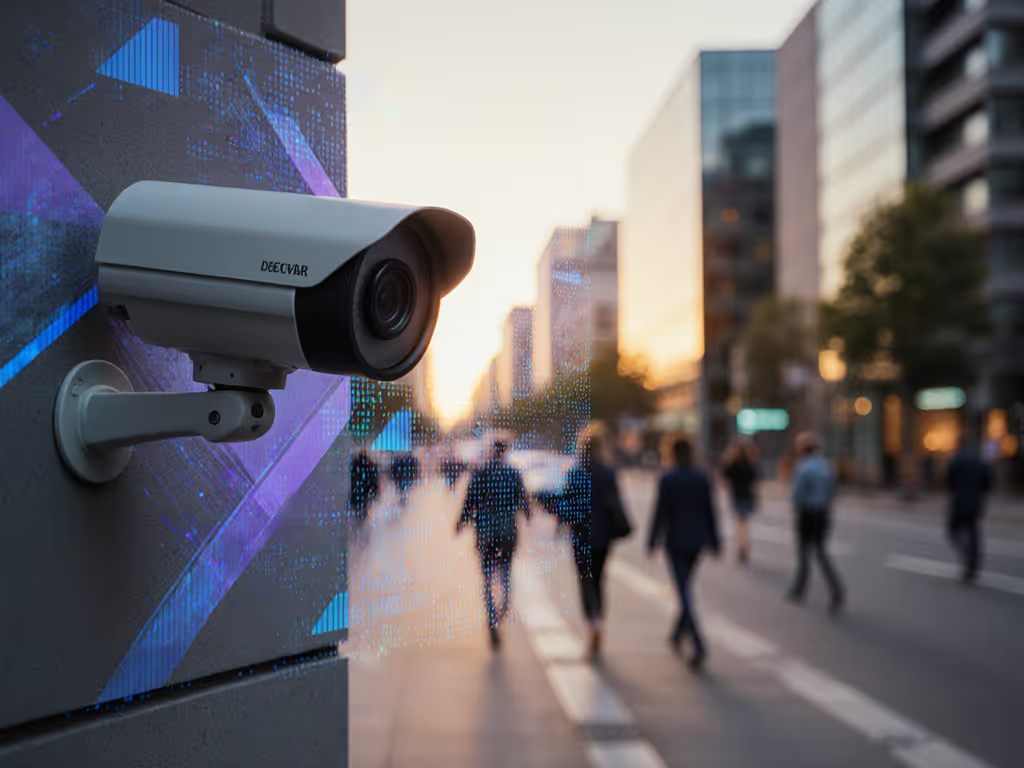
When my neighbor's doorbell camera caught a package theft on our street, the footage should have been evidence. Instead, it became a digital neighborhood watch: faces and license plates leaked into a group chat, a Ring community post, and a few viral social-media threads before anyone realized what had happened. No malice. No criminal intent. Just frictionless sharing of data that neither my neighbor nor anyone else thought to lock down. That moment taught me that differential privacy security cameras and thoughtful anonymized video analytics aren't about paranoia; they're about resilience. They're how you keep evidence in your hands and prevent your home's data from becoming someone else's story. If an incident occurs, follow our evidence submission guide to keep footage admissible and useful.
Differential privacy is emerging as a critical answer to a question most camera owners don't know they should be asking: How do I analyze my footage for threats without creating new ones? This guide walks through the essential questions (what it is, why it matters for video, and how it changes the rules of what "secure" means).
What Is Differential Privacy, and Why Does It Matter for Video?
Q: I've heard "differential privacy" thrown around. Is it just another privacy buzzword?
No. Differential privacy is a mathematically rigorous framework, not a marketing term. It works like this: imagine you run an analysis on your video (say, counting pedestrians or detecting package deliveries). Differential privacy guarantees that an adversary analyzing the result cannot reliably tell whether your camera was on, what you recorded, or who walked past. The math holds even if the attacker has access to all other data, all other cameras, or years of patterns. It's not perfect anonymity; it's provable privacy loss bounded by a parameter called epsilon (ε). For implementation details and tuning epsilon for camera analytics, see how differential privacy protects camera analytics.
For homeowners and small-business owners, the practical implication is stark: you can extract useful insights from your footage (person detection, vehicle counts, package arrival alerts) without broadcasting raw video or relying on third-party cloud processing. Privacy-preserving AI analytics stops being abstract when you realize it means your security system doesn't have to choose between "dumb and private" or "smart and exposed."
Q: How is differential privacy different from just blurring faces or anonymizing video?
Face blurring and anonymization are post-processing tricks. They reduce what's visible, but they don't guarantee privacy against sophisticated attackers. Someone with auxiliary knowledge (your neighbor's schedule, the color of your car, the time you leave for work) can often re-identify you even from blurred footage. Differential privacy, by contrast, adds controlled randomness at the algorithmic level, ensuring that the output of an analysis leaks no measurable information about any individual. It's the difference between "harder to recognize" and "mathematically indistinguishable from a system that didn't film you at all."
How Does Differential Privacy Work in Video Analysis?
Q: Does differential privacy mean my camera adds noise to the video and I get ugly, unusable footage?
Not necessarily. Differential privacy can be applied at the analysis stage, not the recording stage. Here's the cleaner model: your camera captures full-quality video and stores it locally (encrypted, under your retention policy). When you or an authorized analyst want to ask a question ("Did a person approach the front door yesterday at 3 p.m.?") differential privacy mechanisms answer that query with a small amount of noise added to the result, not to the footage itself. You still have clear, usable evidence if you need it for police or insurance; the privacy guarantee protects against the secondary exposure of aggregate patterns or repeated queries.
Some systems do blur the video itself before analysis (by randomly sampling and reconstructing pixels to protect sensitive visual elements while preserving enough information for detection). This approach trades some picture quality for stronger privacy guarantees upfront, which may make sense if your threat model includes an attacker with access to your storage medium.
Q: Can I actually use video analyzed with differential privacy as evidence?
Yes, provided the full, unaltered original is stored locally and under your control. The analysis ("a person was detected at the front door") is protected; the source material remains admissible. Police, insurers, and courts care about the raw footage and clear timestamps, not the privacy-preserving mechanism you used to flag it. This is why aggregate data collection security and local retention matter: minimize what leaves your system, secure what stays, and the chain of evidence remains intact.
Why Local Storage and Encryption Matter Alongside Differential Privacy
Q: If differential privacy is so good, why do I still need local storage and encryption?
Differential privacy answers one question: How do I compute on data without leaking individual information? It doesn't address whether your camera uploads footage to the cloud, who has access to the NVR, or what happens if the device is stolen. Encryption protects the data in transit and at rest. Local storage means the data never leaves your premises unless you explicitly export it. Not sure which storage route fits your setup? Our cloud vs local storage comparison breaks down privacy, reliability, and costs. Differential privacy ensures that even when data is analyzed or queried, the output is privacy-hardened.
Think of it as layers. Encryption is the lock. Local storage is the safe. Differential privacy is the principle that even if someone learns the safe was opened, they can't infer what was inside. Minimize, then secure. Apply all three and you've addressed the full chain of custody.
Q: Doesn't local-only storage mean I can't use AI analytics if my camera doesn't have enough processing power?
It depends on your setup. Some cameras run lightweight AI models on-device (person/vehicle detection is now cheap to compute). For a deeper look at processing trade-offs, read our on-device vs cloud AI comparison. Others can offload analysis to a local NVR or a home server while keeping footage encrypted and on-premise. The privacy win comes from choice: you decide whether cloud processing is required, not the vendor. If you do need cloud analytics, differential privacy is how you ensure the vendor's algorithms don't become a back door to your data. It's the difference between "cloud required, privacy optional" and "cloud optional, privacy guaranteed."
Regulatory and Ethical Dimensions
Q: Does differential privacy help with GDPR, CCPA, or other privacy regulations?
It can. GDPR-compliant analytics ideally means you collect less data to begin with (the minimization principle). Differential privacy is a recognized method for reducing the re-identification risk of data you do retain. Many regulators now view differential privacy as part of a defensible privacy-by-design framework. However, laws vary: GDPR still requires consent before processing, and some jurisdictions require deletion of raw data after a set retention window. Differential privacy doesn't replace those obligations; it reinforces them by ensuring that even if data is retained longer than ideal, the privacy loss is mathematically bounded and visible.
Legal counsel should guide your setup, but the principle is clear: differential privacy is a control you retain. It's not a loophole.
Q: Isn't differential privacy just another form of surveillance creep with a better name?
Not if you're the one applying it. Differential privacy is a tool. A government using it to publish census data is protecting citizens. A corporation using it to justify harvesting more data under the guise of "privacy preservation" is normalizing surveillance. The ethical boundary is ownership and consent. If you control the camera, the NVR, the retention policy, and the decision to analyze, then differential privacy is a privacy reinforcement. If a vendor or landlord controls those levers and deploys differential privacy as a reason to keep footage longer, it's surveillance with better optics.
Stay skeptical. Privacy done right (the kind that improves reliability, not just optics) means you decide what's collected, how long it's kept, and what's analyzed. Differential privacy is the mechanism; control is the prerequisite.
Practical Considerations and Limitations
Q: What's the trade-off? Differential privacy sounds too good, what's the catch?
There are two:
- Accuracy cost: Adding privacy-preserving noise reduces the statistical confidence of queries. Instead of "a person was detected 100 times," you get "approximately 97 to 103 times." For most security use cases (alerts, daily counts, trend spotting) this is acceptable. For forensic precision, it may not be.
- Complexity: Implementing differential privacy correctly requires expertise. A poorly tuned epsilon wastes privacy budget; a poorly chosen sampling strategy leaks information anyway. Vendor implementations vary widely, and "privacy washing" (claiming differential privacy without rigorous proof) is common.
The catch isn't differential privacy itself; it's due diligence. Ask vendors: What's the epsilon? How is noise added? Have results been peer-reviewed? Can you inspect logs of queries and privacy loss? If answers are vague, the tool is only as good as the transparency behind it.
Q: What's the best epsilon value for a home camera system?
There's no universal answer. Epsilon is a privacy budget: lower epsilon means stronger privacy, higher epsilon means better accuracy. For event counting ("how many deliveries") epsilon of 1 to 2 is often reasonable. For person identification across multiple days, epsilon may need to be lower (0.5 to 1). The right value depends on your threat model. Work backward from the question: "What queries do I actually need to run?" Then choose epsilon to make re-identification of individuals impractical even with auxiliary knowledge.
Moving Forward
Differential privacy is not the only answer to surveillance creep, but it's an important one. It shifts the burden of privacy from obfuscation (hope no one recognizes you) to mathematics (it's provably hard to identify you). For homeowners and small-business owners skeptical of cloud lock-ins and privacy theater, it's a tool that aligns your camera's intelligence with your control.
If you're designing or evaluating a camera system, ask: How is data minimized? Is encryption on by default? What analytics can stay local? If cloud analysis is needed, is differential privacy applied? And critically: do I own the policy, or does the vendor?
The goal isn't zero surveillance. It's surveillance that serves you, not the other way around. Collect less, control more. That's how you keep evidence in your hands and privacy leaks out of someone else's group chat.