Blockchain Security Cameras: Verified Evidence You Can Trust
By Naomi Feld • 29th Nov
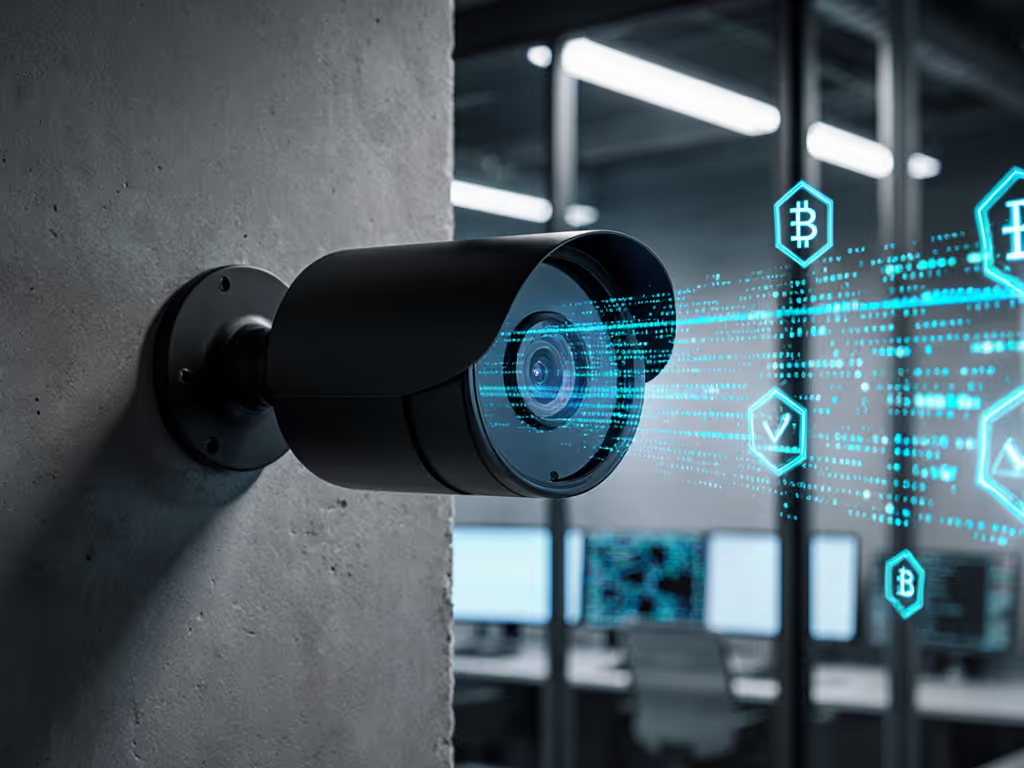
For homeowners and security professionals who've ever faced the frustration of unusable footage during critical moments, blockchain security cameras represent a significant advancement in creating verified security footage that withstands scrutiny. These systems address the fundamental weakness of conventional surveillance: the inability to prove footage hasn't been altered after capture. If you're weighing storage approaches that preserve integrity and uptime, see our cloud vs local storage comparison. Unlike traditional cameras that store video on vulnerable centralized servers or easily corrupted SD cards, blockchain-enabled systems establish an immutable chain of custody from the moment recording begins, a feature that transforms ordinary video into evidence that holds up when it matters most.
Evidence First, Technology Second
When evaluating security systems, I prioritize evidence framing over feature lists. The reality is that most security footage fails as evidence not because of poor resolution, but because of compromised integrity. A recent industry study found that over 70% of digital evidence submitted to law enforcement is rejected due to questions about authenticity or chain of custody. Traditional systems store video in ways that leave too many opportunities for tampering (whether through altered timestamps, selective editing, or simple file corruption during transfer).
The critical threshold for usable evidence isn't megapixels; it's verifiable integrity. Consider a case I reviewed where midnight footage showing a vehicle leaving the scene was dismissed because the timestamp couldn't be independently verified. Contrast this with a situation where balanced exposure, steady bitrate, and clean audio captured a readable plate; police called the footage "boring, in the best way" because it required no interpretation, only verification.
How Blockchain Transforms Security Footage
Blockchain security cameras work by creating cryptographic verification of each video segment at the source. Rather than simply recording footage, these systems:
- Generate a unique hash of each video segment before it leaves the camera
- Record these hashes on a decentralized blockchain ledger
- Create time-anchored proof that the footage hasn't been altered
- Maintain a verifiable chain of custody from capture to presentation
This process enables footage integrity verification that satisfies legal standards for evidence admission. To ensure a smooth handoff to investigators, follow our guide to submit security footage police will actually use. When a blockchain security camera system functions properly, any alteration to the video, no matter how minor, would break the cryptographic chain, making tampering immediately detectable.
Unlike cloud-based systems that rely on a single provider's security measures, blockchain creates a distributed verification system where multiple nodes independently confirm the integrity of stored hashes. This architecture directly addresses the vulnerability of traditional systems where a single compromised server could undermine the authenticity of all footage.
Comparative Analysis: Evidence Readiness Factors
| Evidence Factor | Traditional Security Cameras | Blockchain Security Cameras |
|---|---|---|
| Timestamp Verification | Relies on internal clock, easily altered | Cryptographically secured, blockchain-anchored |
| File Integrity | No built-in verification; requires manual checks | Automatic hash verification against blockchain record |
| Chain of Custody | Paper trail vulnerable to gaps or challenges | Automated, immutable digital record from capture |
| Tamper Detection | Limited to file metadata analysis | Immediate cryptographic mismatch detection |
| Court Acceptance | Often questioned without additional verification | Growing acceptance as tamper-proof security systems meet evidentiary standards |
This comparison reveals why blockchain security cameras are gaining traction among evidence-conscious users. It's not about having "more features" but about solving the fundamental problem of trustworthiness in digital evidence.
Critical Evidence Requirements Blockchain Addresses
For security footage to serve as evidence, it must satisfy three clear thresholds:
- Authenticity: Proof the footage shows what it claims to show
- Integrity: Verification that content hasn't been altered
- Context: Clear time, location, and environmental information
Blockchain security cameras directly address these requirements through blockchain evidence validation processes. When a camera generates a hash of video segments and anchors them to the blockchain in real-time, it creates an independent verification mechanism that doesn't rely on the camera manufacturer's claims or a cloud provider's security measures.
The technology matters most when milliseconds count. Consider nighttime incidents where license plates must be readable despite motion blur. Conventional systems might capture the scene, but without verified timestamps and integrity checks, the footage becomes questionable. Blockchain-verified systems provide both the visual evidence and the proof it hasn't been manipulated, a combination that turns video into evidence courts accept.

Implementation Considerations for Evidence-Ready Systems
When selecting a blockchain security camera system, prioritize evidence requirements over technical specifications:
- Verification workflow: How easily can you generate a verification report showing footage integrity?
- Local processing: Systems that hash footage on-device before transmission minimize tampering opportunities
- Blockchain transparency: Look for systems using established blockchain platforms with public verification
- Export capabilities: Court-admissible formats with embedded verification data
Most importantly, ensure the system doesn't sacrifice video quality for blockchain features. The highest cryptographic integrity means little if motion blur obscures critical details or poor low-light performance renders footage unusable. Evidence quality starts with optical performance; no blockchain can fix footage that lacks essential details at capture.
The Verdict: Evidence You Can Trust
Blockchain security cameras solve the critical problem of verification that has plagued security footage for decades. While no technology can guarantee perfect footage in all conditions, these systems provide the verification framework that transforms video from "something that happened" to demonstrable evidence.
The most valuable security footage isn't the most visually impressive. It is the most verifiable. As one police evidence technician told me after reviewing a case, "Give me boring, consistent footage with clear verification over fancy features any day." When evaluating systems, apply objective failure notes: would this footage stand up in court without additional verification steps?
For homeowners and businesses needing court-admissible security footage, blockchain security cameras represent a significant evolution in evidentiary quality. They don't replace good optics, proper installation, and proper lighting, but they do solve the verification problem that has rendered so much otherwise usable footage inadmissible. For practical setup that strengthens evidence, use our camera placement guide to eliminate blind spots. In security, clarity plus context turns video into evidence when minutes matter most.
Related Articles